Categories
Applying the identity Buses Developing the Manual East Kent Eastern National London Country

Corporate disobedience: subverting the identity

Some companies found practical reasons to take a different approach to applying Norman Wilson’s carefully-crafted designs.

In the spring of 1972 a handful of NBC’s local operating companies were actively involved in trialling the new identity for the company’s buses. Notably, Crosville experimented with the green version, while Alder Valley’s Reading depot provided vehicles as the testbed for Norman Wilson’s proposed layout and the use of the new corporate shade of poppy red.

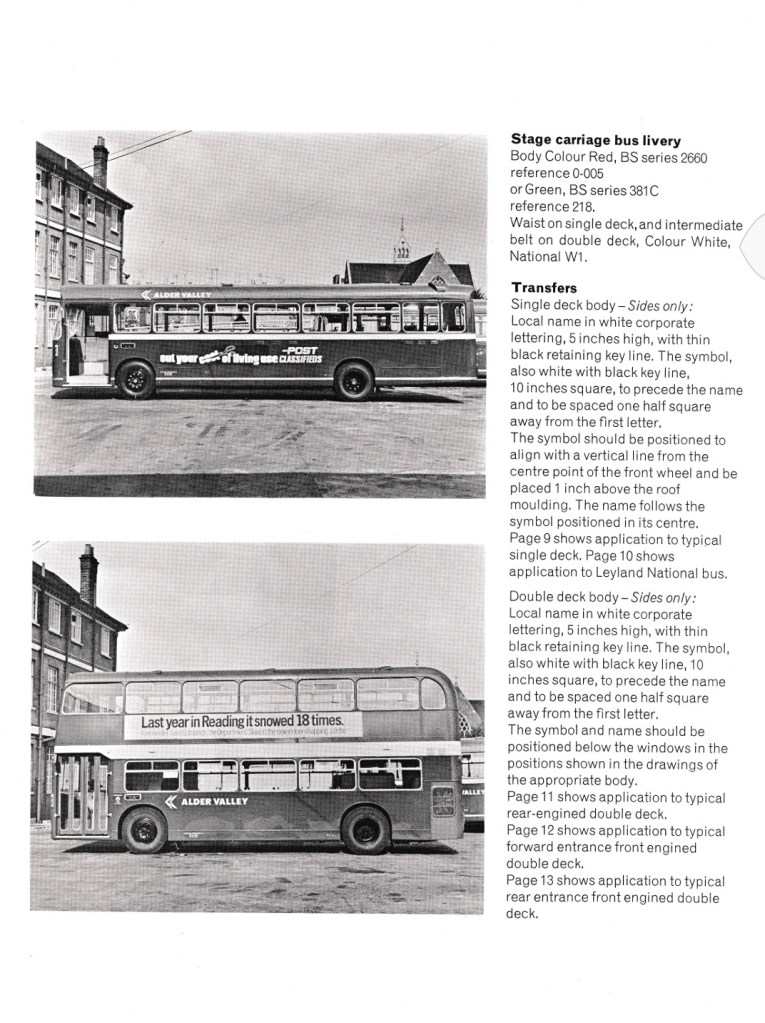
Consequently the first version of Wilson’s Corporate Identity Manual, developed in the spring in close partnership with NBC Group Public Relations Officer Ron Whitehouse, features detailed illustrations using photographs of Alder Valley’s double- and single-deckers in the new local bus identity.

In mid-Summer, and following up on the instructions already issued for the White Coach livery, on 11 August Ron Whitehouse wrote to the General Managers of NBC’s subsidiary companies to provide the first in a series of drawings showing how the new identity should be applied to buses. This included the precise position of the new symbol and lettering across a range of typical vehicles, from venerable double-deckers to the brand-new single-deck Leyland National, designed and manufactured as a joint venture between NBC and Leyland Vehicles, and styled by the legendary Italian designer Giovanni Michelotti.
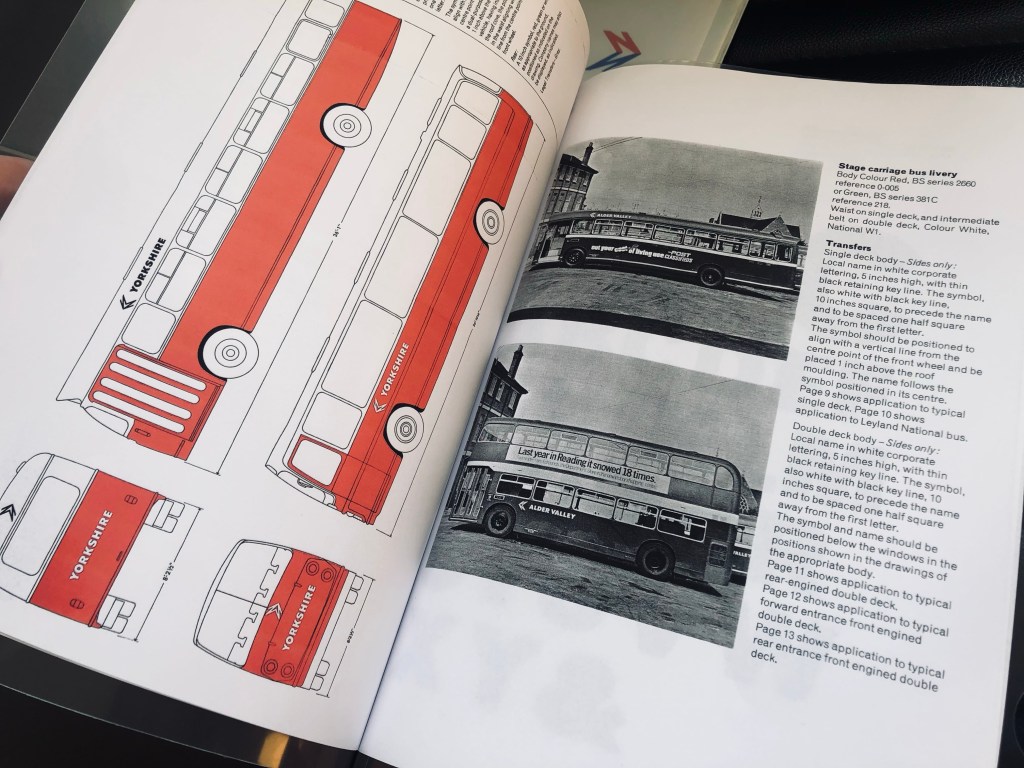
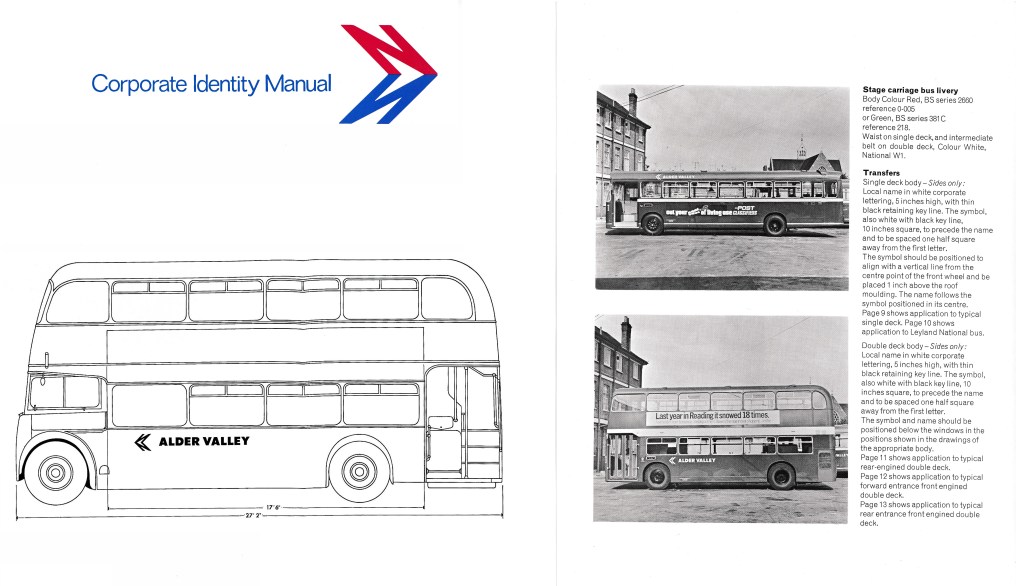
Livery instructions and illustrations from the 1972 Corporate Identity Manual. The page of photographs, taken at Alder Valley’s Reading depot by NBC photographer Tony Whitehead, shows the correct position of the symbol and lettering on standard buses, and was issued in August 1972. The page on the left, illustrating the semi-coach livery, was issued later for insertion into the manual.

Through the summer months Norman Wilson’s team were kept busy, working with Ron Whitehouse and his NBC publicity staff to develop a uniform approach across a huge variety of vehicles. “It took forever to draw all the coaches and buses” remembers Antony Dawson, who with Rodney Morris was Wilson’s design associate working on the project to finalise and roll out the identity in 1972. “NBC managed to give us most of the drawings for their fleet, but then we had to go back to the coach builders to get their drawings for the rest. We had to devise something that worked across multiple buses.” New pages and illustrations were issued and sent to the local companies to be added into the loose-leaf A4 Corporate Identity Manual. The A4 pack of instructions and diagrams became a reference guide for companies as they made the rapid switch to the new identity.

In 1973, East Kent’s AEC Reliance Plaxton number 37 waits in the sun at Cheltenham coach station. It has been painted into a bespoke ‘semi-coach’ livery, reflecting East Kent’s historic deep red colour, and using the new National lettering to form ‘EASTKENT’, without so much as a hint of the National symbol. Photo: Richard Price collection.

The tight specification however was not to everyone’s liking. East Kent’s works in Canterbury seemed determined to do their own thing. Canterbury took advantage of the lack of instructions on how the identity was to be applied to local coaches to experiment, using a large version of the National lettering to spell out the company’s name, using East Kent’s traditional coach colours dark red bands on a grey or cream body, usually with the NBC symbol, but sometimes omitting it altogether.
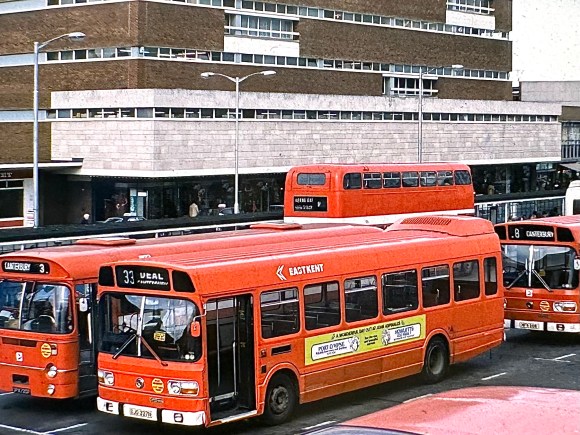
East Kent’s Leyland National 1337 in the early version of the NBC identity – with the company’s unauthorised EASTKENT branding – at Canterbury Bus Station in 1976. Picture: Richard Price Collection.

Meanwhile there was a determined effort to brand the company as EASTKENT, leaving out the gap when applying fleetnames in the new National lettering. The instructions from NBC HQ were to spell out both words with a gap, and East Kent’s publicity consistently followed did so. But the company’s vehicle engineers had other ideas. This was all pretty ironic as the company’s former General Manager, Jim Skyrme, had just been appointed chief executive of the whole of NBC. This effectively made him Fred Wood’s man with the task, among other things, of policing implementation of the new identity. Being close to London, it wasn’t difficult for HQ staff to spot the ‘mistake’ and stamp it out. But – perhaps as in protest at this extension of central control – East Kent buses for years after had an exaggerated gap between the ‘East’ and the ‘Kent’.

In response to NBC HQ’s clampdown on its unilateral branding, East Kent made sure they couldn’t be accused of omitting the gap. Leyland National number 1513 at Canterbury Bus Station in 1986, showing the exaggerated gap between ‘East’ and ‘Kent’, visible on the Bristol VR in the background too.

Other companies got in on the act too. In Chelmsford, Rodney Hawkins took a long look at the new centrally-supplied Eagle Quik-Fix transfers for the new lettering and the NBC symbol. He took a second careful look at the instructions in the Corporate Identity Manual: “The symbol should be positioned to align with a vertical line from the centre point of the front wheel and be placed 1 inch above the roof moulding. The name follows the symbol positioned in its centre.” And for double-deck buses “The symbol… 10 inches square, to precede the name and to be spaced one half square away from the first letter. The symbol and name should be positioned below the windows in the positions shown in the drawings of the appropriate body.” Studying the photographs and diagrams, Rodney frowned.
Rodney was the Chief Engineer for the Eastern National Omnibus Company. He knew his vehicles, and he knew where the panel joints were. “That’s no good” he muttered to himself, thinking how the flimsy transfers would look at the joints after a few runs through the vehicle washer. He issued instructions to his coach painters to apply and space the symbol and the two words of the company name to avoid fixing the new transfers across panel joints and rivets, countering the instructions from NBC HQ and leading to some idiosyncratic layouts and extra spacing. This was particularly true for the new Leyland National. With its interchangeable, easily removable bodyside panels, some joked that it was largely made from rivets.

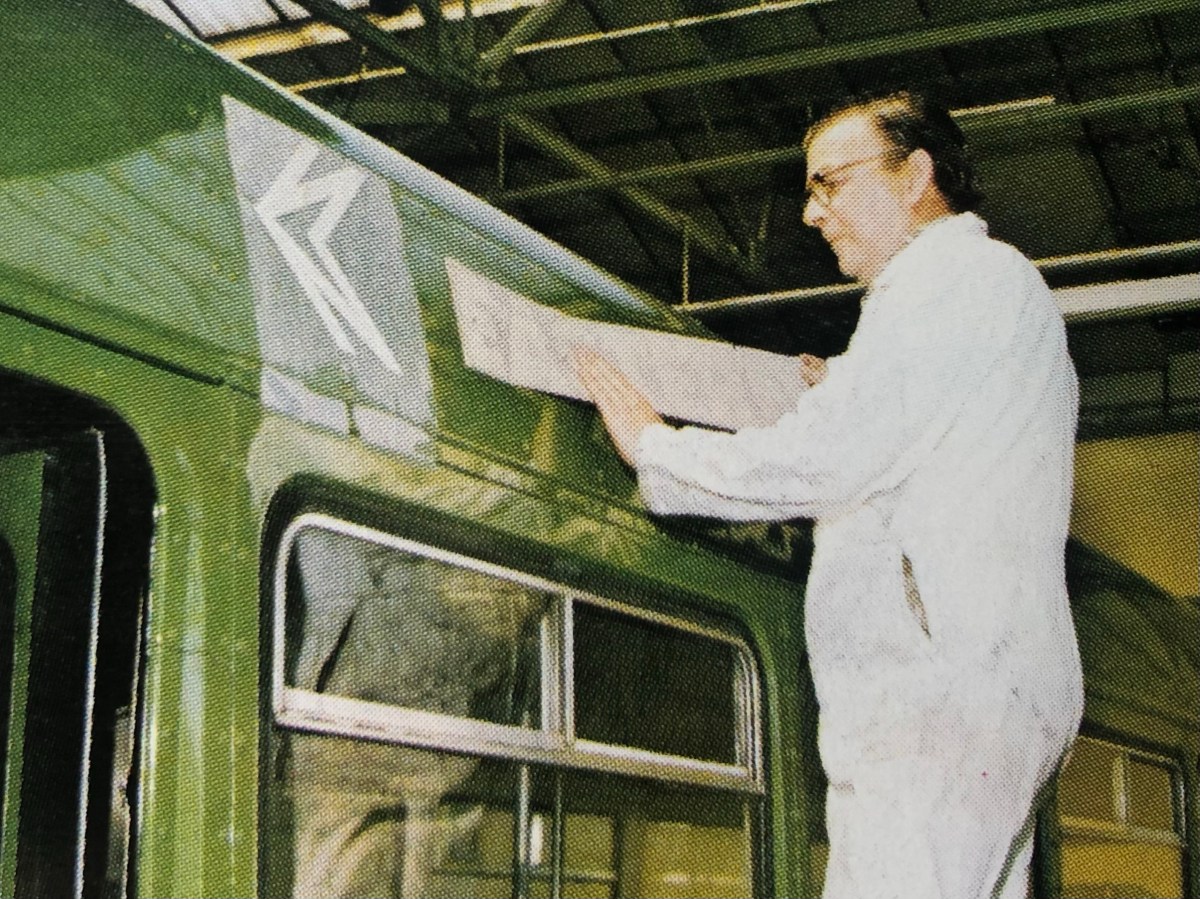
At Eastern National’s Chelmsford works, Fred Brewster undertakes the fiddly task of applying corporate identity lettering and symbol transfers to a new Leyland National in 1973. Under Rodney Hawkins’ instructions, he is placing the symbol further forward than the manual specified, so that he can squeeze the word ‘Eastern’ into the same panel, without crossing a break or any rivets which might make the transfers come loose in the washing plant. In practice this was only rarely a problem. This act of disobedience wasn’t initially spotted by NBC HQ, however – who included this photo in their 1973 Annual Report to illustrate progress with implementing the corporate identity. Picture: Tony Whitehead/NBC.

Frank Brewster, in the paint shop, was a skilled coach painter. In the photograph Frank is seen at Chelmsford central works applying the NBC symbol and Eastern National lettering to a new Leyland National in 1973. His former colleagues remember Frank as a skilled and kind man. They also remember difficulties in applying the transfers. “I hated that job with the Eagle Quik-Fix transfers” remembers Chris Critchett, formerly of Eastern National: “I often used to cock it up somehow”.

Eastern National’s idiosyncratic approach to placing the symbol and lettering continued into the 1980s. Leyland National no 1999 picks up passengers on a local service in Chelmsford in March 1980, showing its symbol and ‘National’ squeezed into the second body panel, with ‘Eastern’ in the next panel, positioned to avoid applying transfers over the panel-end rivets. The Wilson designs, in contrast, required the symbol to be positioned so that the point of the arrow is parallel with the centre of the wheel arch, and spaced to avoid the appearance of symbol and lettering crammed together.. Picture: Richard Price Collection.

The result was a variety of layouts on the sides of buses where the position and spacing of the symbol and fleetname was different from what the Manual specified. Being close to London, Eastern National saw closer attention from the publicity team responsible for the corporate identity, and so more edicts to management requiring the company to toe the line. Judging by pictures from the 1970s though, it seems that Rodney Hawkin’s coachpainters managed to do their own thing for quite a while!

With Fred Wood personally regarding the new identity as a key part of his commercial recovery plan for NBC, variations were heavily frowned upon by HQ. It was far from unusual for company general managers to get disapproving memos from Ron Whitehouse’s team instructing them to follow the carefully-crafted instructions in the manual. Local managers of the time still speak of visits from the ‘identity police’ and the occasional sharp exchange. Family members recall Norman Wilson himself cursing loudly at passing vehicles bearing incorrectly-applied liveries and graphics as he drove across the country on family holidays.

Happily, on a Lodekka double-decker it was possible to avoid body panel joints and follow the rules. Eastern National’s 2775 waits at Southend Bus Station in February 1977. Picture: Richard Price Collection.

Bernard Davis, Commercial Manager at London Country, remembers regular visits from NBC head office to check on the application of the identity, and missives to London Country’s bosses when things weren’t done to spec. “Being nearer to London meant we were watched hawkishly” he recalls. “Companies further away got away with all kinds of things. We got special permission for our ‘Green Line’ coach livery, which other companies adopted later. But there was very little flexibility on vehicle liveries – headquarters expected the manual to be followed precisely”.

Read more about how the modernist-inspired design of the NBC identity was shaped by Norman Wilson’s design influences, combining his three key elements: bold, uniform colours, his distinctive typeface, and a striking monochrome version of his NBC symbol, wordlessly conveying the nature of the business, all drawn together in a grid-based layout which brought a sense of uniformity and modernity across disparate companies and an enormous variety of vehicle types.
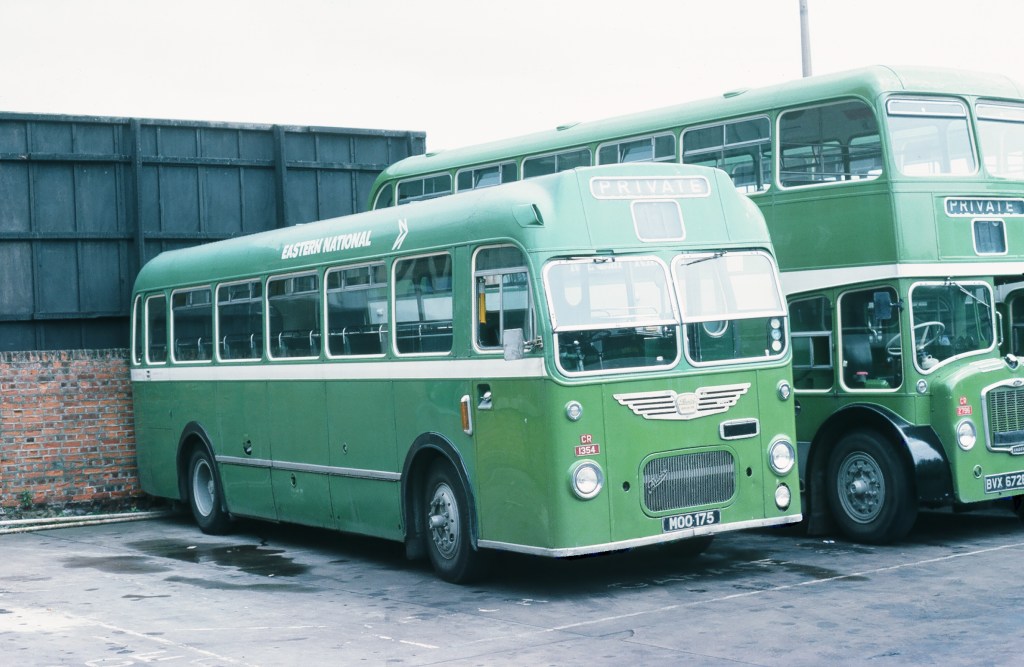
Eastern National’s Bristol MW 1354 illustrates another distinctively-disjointed application of NBC symbol and fleetname, at Colchester depot in around 1975. Picture: Richard Price Collection.

If you have recollections of the roll-out of the new livery, how it was managed, or remember your initial reaction to it, please let us know.  We’d be happy to include these in a future blog, and perhaps in the Manual book itself. Get in touch using the form on this page, or the contact page here: https://nationalbusmanual.com/contact/
Categories
Design East Kent Green Line Manual project publications Midland Red Norman Wilson Northern Southdown Western Welsh

Wilson heads east: the Biennial poster

The designs for the NBC corporate identity were a hit in Czechoslovakia in 1978.

NBC’s corporate identity went global in 1978. Norman Wilson’s work had a history of gaining international recognition, one of the highlights being awarded a certificate of merit at the pathbreaking Typomundus 20 exhibition in 1966 for his graphic designs for Croda, playing with a creative combination of photography and type.

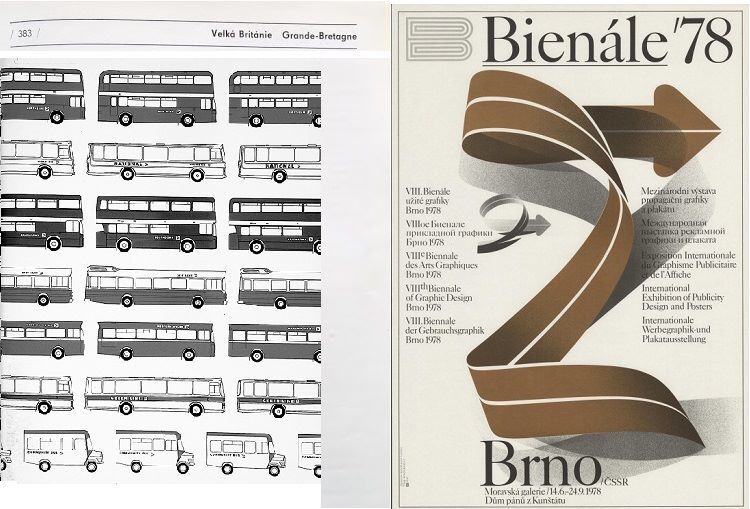
Norman Wilson’s catalogue page from the 1978 Brno Biennial, reproduced in colour for this project.

A decade later, Wilson was asked by NBC to refresh his original 1972 corporate identity designs, making more use of the two-colour version of his N-and-shadow symbol; expanding its coverage to uniforms, built environment and signage. The whole thing was consolidated into a sturdy ring-bound folder, which would be added to over time, and would be more durable in garages and workshops than the slim-bound A4 sheets released as the original Corporate Identity Manual in 1972. 

It was this more substantial Corporate Identity Manual which Wilson decided to submit for exhibition at another international festival of graphic design, the Brno Biennale, in 1978. Sponsored by the Ministry of Culture of the Czechoslovak Socialist Republic, the Biennale had been launched in 1963, holding lively events every two years with an exhibition at the Moravian Gallery in Brno, and by the mid-70s had established itself as a prestigious fixture on the graphic design calendar. At the time it was a rare cultural event, attracting interest and exhibitors from both sides of the iron curtain.

The 1976, ring-bound edition of the NBC Corporate Identity Manual, the contents of which were exhibited in Brno in 1978.

Wilson submitted the NBC manual, which was accepted as one of the leading examples of recent British design. The illustration used for the catalogue showed a selection of livery diagrams, some of which also appeared in different forms in the manual. A smaller version was used for the cover of the 1976 NBC Annual Report.

The original page and cover of the 1978 Brno Biennial catalogue.

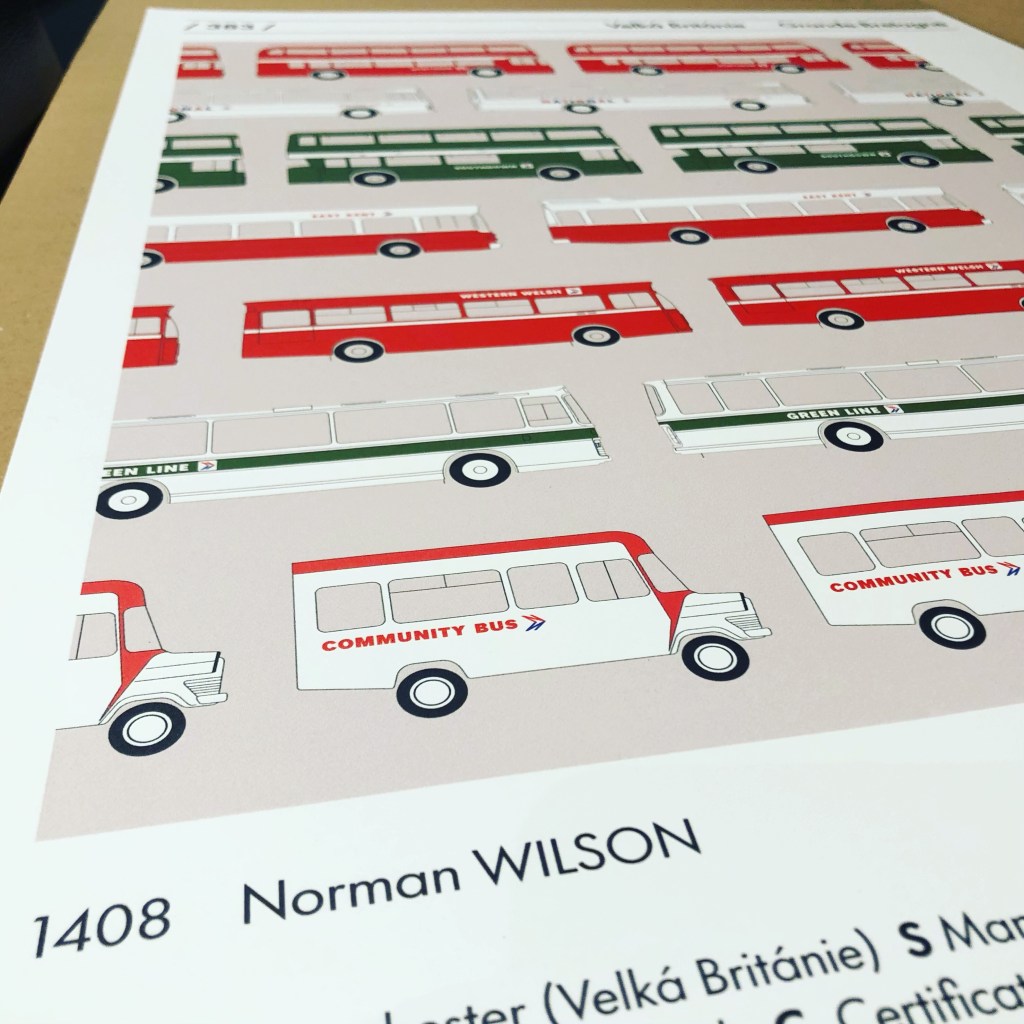
It shows a selection of typical NBC vehicles in different colours, showing the variety of services the company provided, and to emphasise its national coverage, fleetnames included Northern for the north, Southdown for the south, East Kent representing the east, Western Welsh for the west and Wales, and Midland Red for the centre.

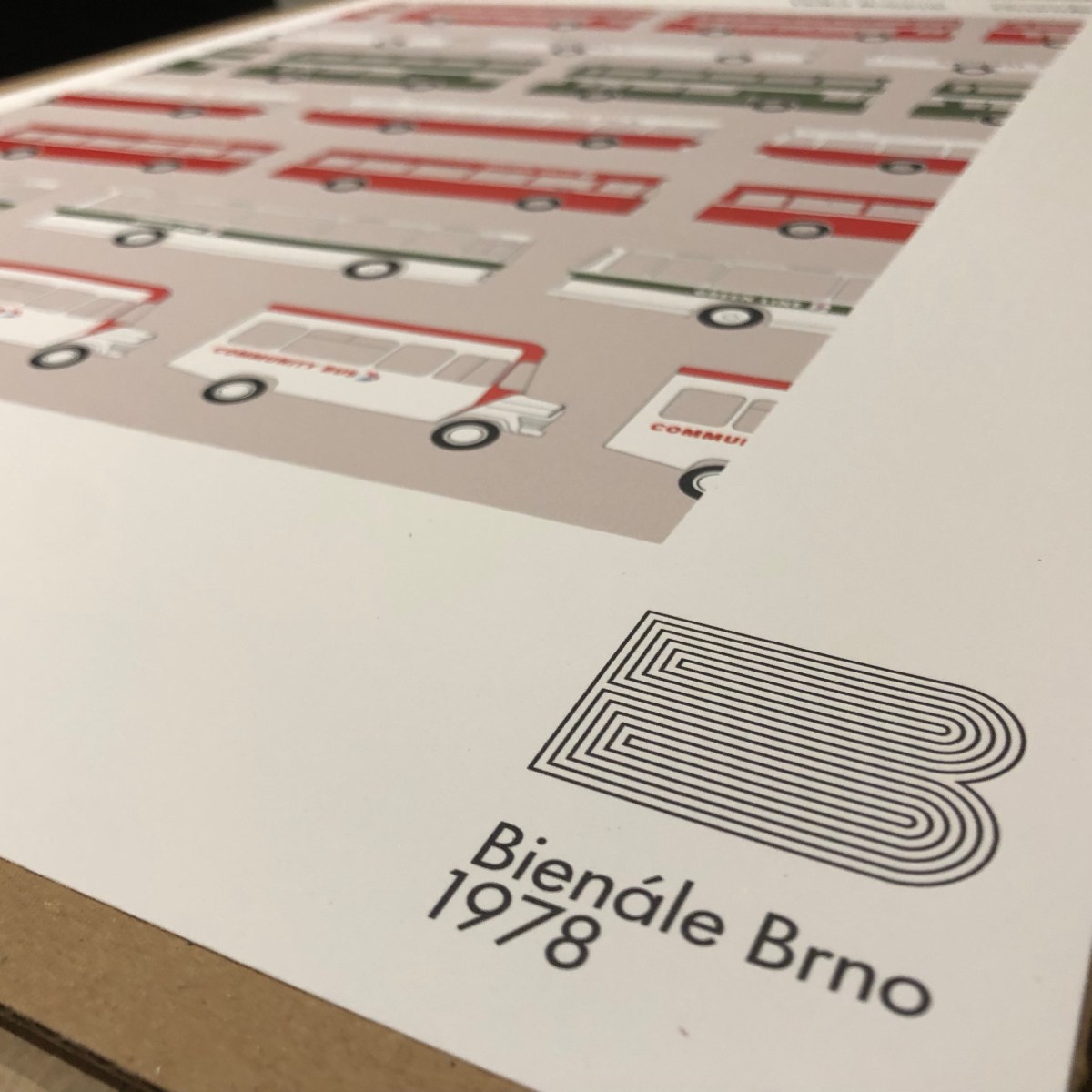
The recreated Brno catalogue page, now available to order.

The catalogue pages were produced in black and white, but after 44 years we’ve reproduced it as a colour poster, probably a bit crisper than the original. It’s available to order now via e-bay, in A2 and A3 sizes. Please allow around 7 days for delivery. Follow this link for more details and to order. Click here if you want A3 size.

Huge thanks to Jean Horsfall, Martyn Cummins and Nick Job for their enormous help with this reproduction.

Save the Brno Bienále!

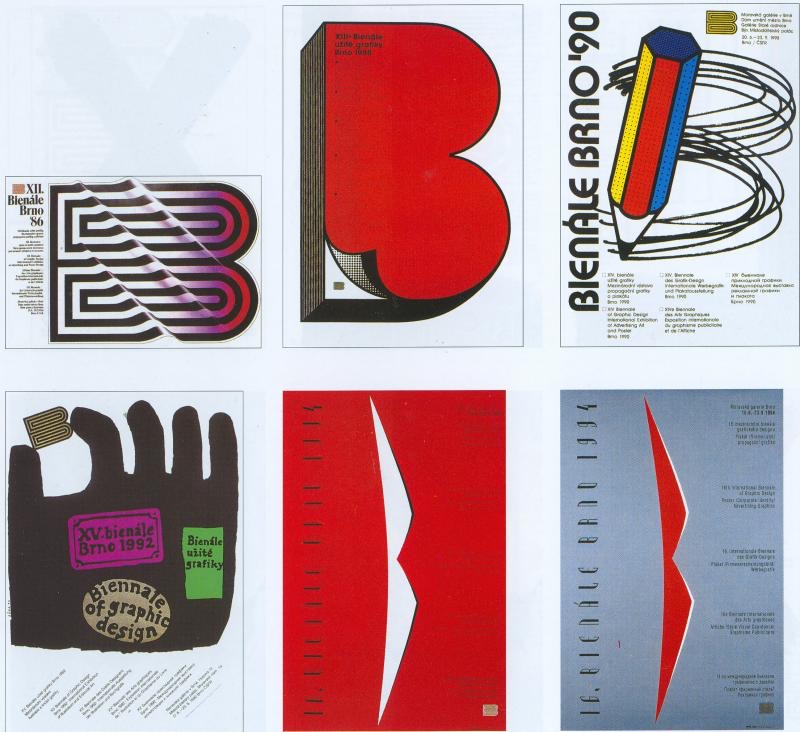
Launched in 1963 as a cultural bridge between east and west Europe, the Brno International Biennial of Graphic Design has provided a major international platform for exhibitions, discussions, and educational programmes in graphic design for the last six decades. 

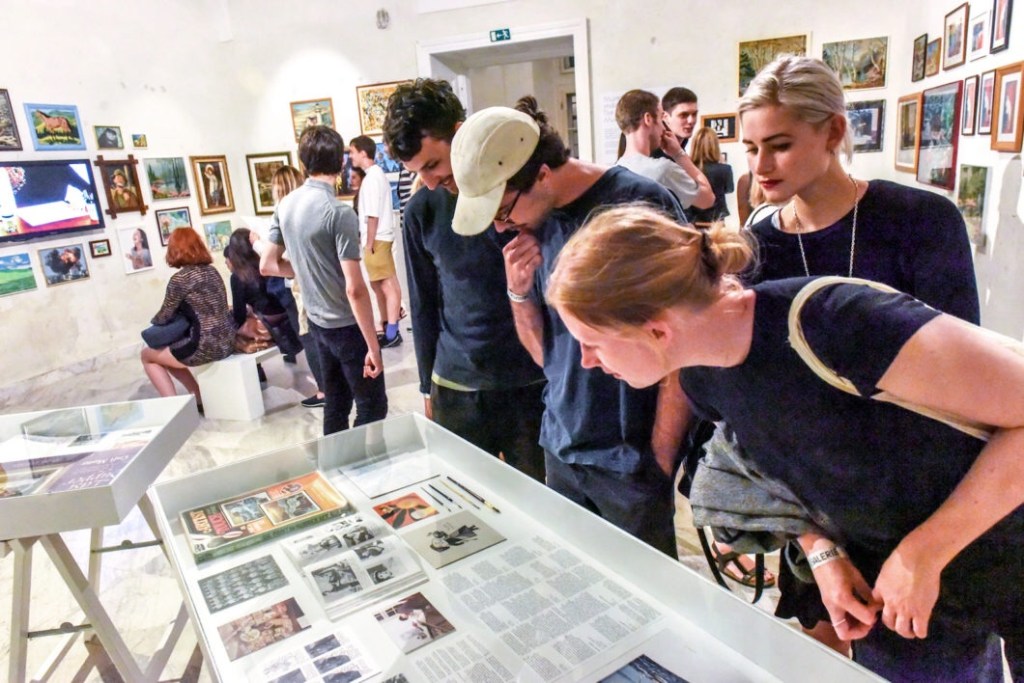
Brno Bienale, Moravian Gallery, 2018, photo: arttalk.cz

Until now, the Biennial has continued to run every two years, attracting designers and visitors from all over the world helping to influence and inspire whole generations of graphic designers.

The Biennial is now under threat, as the Moravian Gallery which hosts it is investigating an alternative online forum which would dispense with the in-person exhibitions and events. Find out more here, and help to save the Brno Biennial by signing the petition to the Moravian Gallery and the Czech Ministry of Culture here.

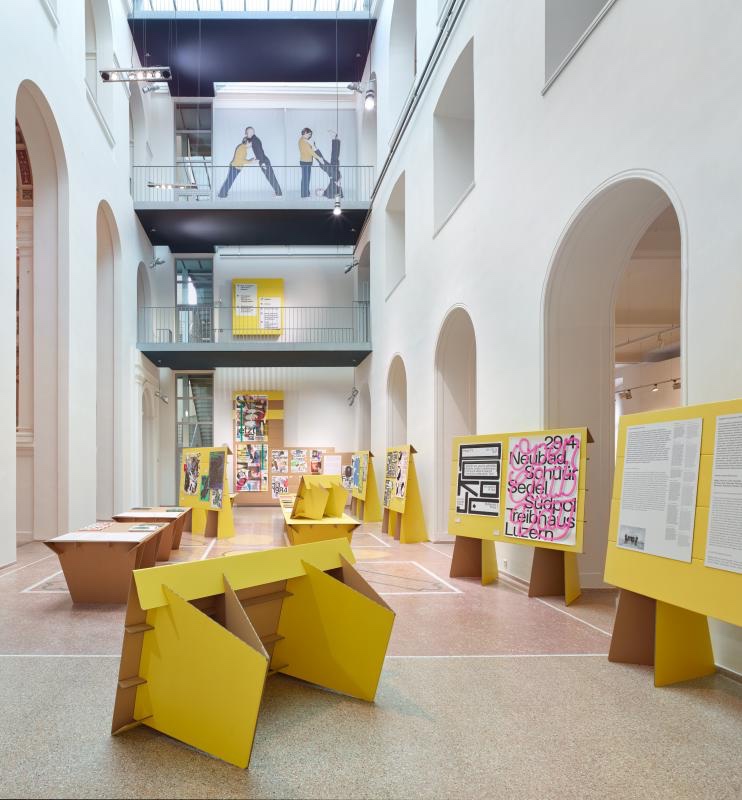
Brno Bienale, Moravian Gallery, 2018, photo: 28.bienalebrno.org.

Read more about how the modernist-inspired design of the NBC identity was shaped by Norman Wilson’s design influences, combining his three key elements: bold, uniform colours, his distinctive typeface, and a striking monochrome version of his NBC symbol, wordlessly conveying the nature of the business, all drawn together in a grid-based layout which brought a sense of uniformity and modernity across disparate companies and an enormous variety of vehicle types.

If you have recollections of the roll-out of the new livery, how it was managed, or remember your initial reaction to it, please let us know.  We’d be happy to include these in a future blog, and perhaps in the Manual book itself. Get in touch using the form on this page, or the contact page here: https://nationalbusmanual.com/contact/

Categories
Applying the identity Buses East Midland Green Line Mansfield District NBC50 Norman Wilson Trent West Riding Yorkshire Traction Yorkshire Woollen

A modernist summer on the buses

Fifty years ago, in August 1972, the new identity was being rolled out across England and Wales

It’s a miserable week of weather at the start of August, with low temperatures across Britain and the odd spell of torrential rain. In depots across England and Wales, managers, engineers are already embroiled in the business of changing their vehicles over from their long-established, traditional colours to the new Corporate Identity.

Pages from the first edition of the NBC corporate identity manual of 1972, issued shortly after the 19 July letter. Source: NBC/The Bus Archive.

Since instructions and diagrams were sent to the local operating companies in June, the first pages of the new Corporate Identity Manual have been supplemented with detailed instructions on how to apply the new liveries, paint specifications and the precise configuration of the new symbol and company names. On 11 August, Ron Whitehouse, Group Public Relations Officer, writes to the General Managers of the 40 or so subsidiary companies issuing additional pages for the manual, the first in a series of drawings showing how the new identity should be applied, including the precise position of the new symbol and lettering, across a range of typical vehicles from venerable double-deckers to the brand new single-deck Leyland National, designed and manufactured as a joint venture between NBC and Leyland Vehicles.

Coaches are the priority as NBC seeks to capitalise on the growing recognition of the new ‘white coach’ express network. For buses, each company has been encouraged to paint a number of vehicles as soon as possible to make sure there is momentum behind a public campaign planned for the Autumn.

Local operating companies have also been encouraged to apply the identity in interim form, applying the new symbol and distinctive lettering to buses their traditional liveries so that it will gain recognition before proper repainting can be done.

Local companies across England and Wales applied the new identity following the precise layout specified in the Corporate Identity Manual, the first loose-leaf pages of which appeared in June 1972, with additional detailed drawings and instructions following over the following weeks for companies to add in to their copy of the Manual. Yorkshire Woollen’s Fleetline 693 appears in the new identity after a repaint. The ‘Yorkshire’ company name at the front is a local addition, and not part of the NBC’s standard specification. Photo and copyright: I T Langhorn.

By and large it’s going well. Coaches are being repainted into white at a rapid rate, while buses are reappearing in poppy red and leaf green as they complete routine overhauls. But there are a few areas which need attention.

First, both Norman Wilson, the design consultant responsible for the new identity, and the NBC’s HQ staff responsible for implementing it, are dissatisfied with the results of the ‘interim application’ using existing liveries and in many cases, cream-coloured lettering to match the old-style lining on buses. Whitehouse’s letter of 11 August suggests that companies “may find it economical to avoid the interim stage of ‘cream’ transfers and apply ‘white’ transfers immediately… For those fleets with waists or intermediate bands of cream, white transfer can be applied and the band painted white immediately without waiting for a total re-paint. For complicated liveries, eg cream window mouldings; more than one intermediate band, etc, this suggestion will not be practical.”

Preparing a bulk order of transfers of the monochrome NBC symbol and company names in Wilson’s new National lettering, Whitehouse asks General Managers to let him know how many white and how many cream transfers they will need for each fleets. An effect of this instruction is that only a few companies adopt the interim cream version of the new identity.

The application of the Bauhaus-inspired NBC symbol and lettering in traditional cream to match the existing liveries blunted the modernising intent of the corporate identity, and was short-lived. Devon General’s modern NBC symbol and fleetnames have been applied in cream to the traditional Exeter Corporation colours of Leyland Titan PD2 no 236, seen in Exeter in 1973.. Picture: Richard Price Collection.

Second, the carefully-specified coach and bus liveries omit a whole category of vehicle, and across NBC company chief engineers are puzzled: Yorkshire Traction’s chief engineer exclaims on 8 August that “there appears to be a gap, in that we do not know what livery to paint our semi-coaches… and I have no instructions on this point.”

For express and tour services, and for local hire, the new National white coach livery is to be used. For local buses, it’s all-over red or green with white bands, depending on ‘the company’s tradition’. But the corporate identity does not yet cover the company’s many ‘semi-coach’ or ‘dual-purpose’ coaches and buses Equipped with coach seats, for many NBC subsidies these provide some of their higher-profile, higher-profit services such as regional express routes or express commuter services on regional routes into London, notably London Country’s Green Line routes.

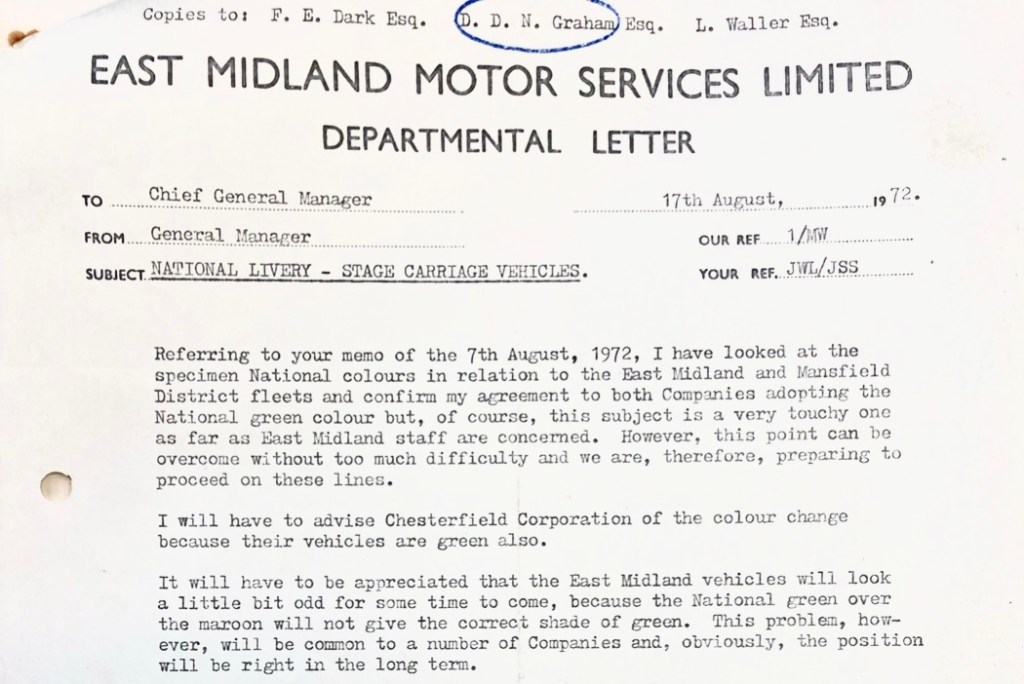
Internal memos from Yorkshire Traction suggest using National white but substituting the local company’s name in Wilson’s new lettering for the ‘NATIONAL’ brand. “To my mind this is an advantage”, he argues, “as we could without too much trouble change vehicles into and out of national livery without a complete repaint.” In a letter to NBC HQ on 17 August, East Midland’s General Manager highlights the problem that “our… semi-coaches have to alternate on stage-carriage [bus] work because they are vehicles receiving bus grant… There is quite a variety of colour styles spread over the years, particularly with coaches … and the only suggestion I can make is that they are painted white with a green band” to differentiate them from ‘normal’ buses. “The semi-coaches will have to be done on a similar basis, although the quantity of green will be greater.”

From the archives: on 17 August 1972, the East Midland General Manager writes on the ‘touchy subject’ of changing company colours as part of adopting the NBC identity. Source: The Bus Archive.

There’s also the question of what to do where the local company’s ‘traditional’ colour isn’t green or red – maroon, say, or blue. Maroon (or ‘dark red’) is generally replaced with NBC poppy red. But the joint companies of East Midland and Mansfield District – using maroon and green respectively – come under pressure to adopt the standard NBC green livery for all of their buses. Their General Manager responds to D Graham at NBC HQ on 17 August relenting: “I confirm my agreement to both Companies adopting the National green colour but, of course, the subject is a very touchy one as far as East Midland staff are concerned.” There are practical issues to deal with too: “I will have to advise the Chesterfield Corporation of the colour change because their vehicles are green also.” And moreover: “It will have to be appreciated that the East Midland vehicles will look a little bit odd for some time to come, because the National green over the maroon will not give the correct shade of green. This problem, however, will be common to a large number of companies and, obviously, the position will be right in the long run.”

The new corporate identity forces some compromises – including the adoption of standard leaf green to replace East Midland’s previous maroon or dark red, reflecting its integration with its sister company Mansfield District. Picture: Martyn Cummins and Richard Price.

To complicate things further, although the company is pressing ahead with the roll-out of the white coach – but “the re-painting of any vehicles cannot be properly undertaken immediately because… the only transfers we have are 50 East Midland suitable for coaches painted in the full National specification, but these have the red line under the Company’s name, whereas, in fact, we are proposing to adopt the National green.”

Having taken the decision to switch company colour from red to green in August 1972, East Midland found itself stuck with a large number of transfers for its coaches with Norman Wilson’s National lettering underlined in red, temporarily halting its roll-out of the new National identity.

Anxieties and practical challenges over which colours to adopt will continue over the coming months. The next blog will look at why, for some reason, NBC HQ turns out to be less than decisive when it comes to the use of National blue.

Read more about how the modernist-inspired design of the NBC identity was shaped by Norman Wilson’s design influences, combining his three key elements: bold, uniform colours, his distinctive typeface, and a striking monochrome version of his NBC symbol, wordlessly conveying the nature of the business, all drawn together in a grid-based layout which brought a sense of uniformity and modernity across disparate companies and an enormous variety of vehicle types.

If you have recollections of the roll-out of the new livery, how it was managed, or remember your initial reaction to it, please let us know.  We’d be happy to include these in a future blog, and perhaps in the Manual book itself. Get in touch using the form on this page, or the contact page here: https://nationalbusmanual.com/contact/
Sincere thanks to The Bus Archive for providing access to the NBC archive and the original papers on which this blog is based.

Look out for the forthcoming article in the modernist magazine by Richard Price looking at the career and impact of Norman Wilson, the graphic designer and typographer responsible for the NBC corporate identity,

Categories
Advertising and publicity Applying the identity Buses Coaches Green Line London Country

The counties of London Country

The NBC Corporate Identity came as a surprise to London Country, in more ways than one.

London Country joined the National Bus Company from London Transport (LT) on 1 January 1970, forming NBC’s biggest subsidiary. On its departure from LT the company introduced its own new identity. Buses and coaches took on a new version of LT’s country-area green livery and a new fleet name. LT’s iconic roundel and Johnston lettering were replaced by a new symbol, nicknamed the ‘flying polo’, representing the shape of the new business’s operating area, which was effectively a ring around London itself. London Country had put a lot of effort into rebranding its services, publicity and buildings across the large part of the south-east of England that the company served.

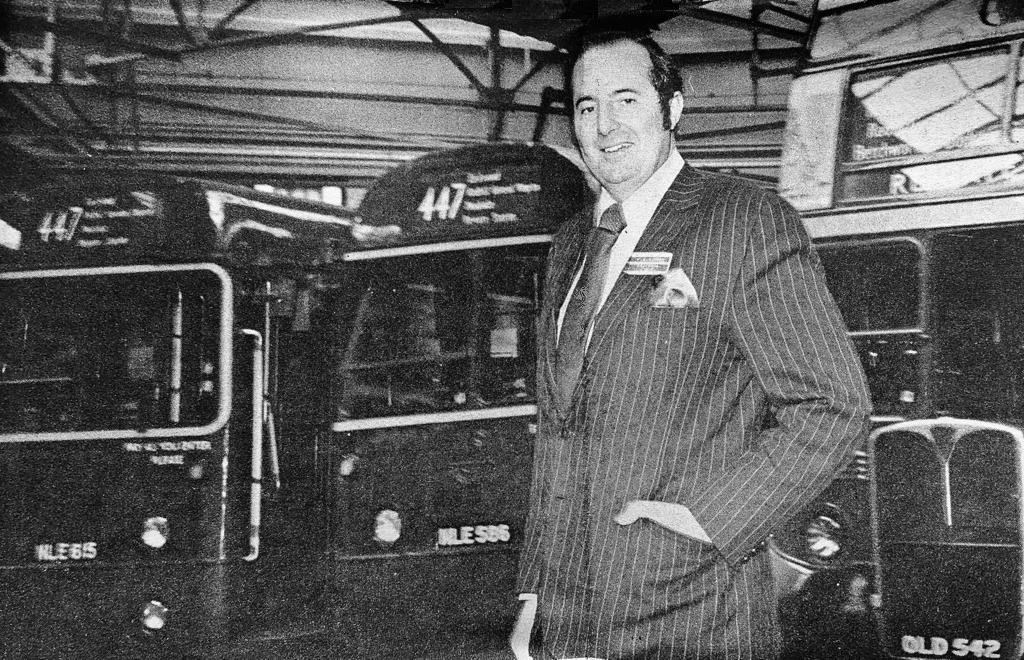
National Bus Company chair Freddie Wood – instigator of the NBC corporate identity ­- visits London Country’s Reigate depot in April 1972, with an array of vehicles in London Country’s own dark-green livery in the background. Photo: Tony Whitehead, NBC.
A picture containing text

Description automatically generated
London Country’s short-lived ‘flying polo’ logo, in use from 1970 to 1972.
London Country’s post-LT local bus livery. National Bus Company

Having invested heavily in the new company brand there was frustration at the requirement, after just two years, to replace it wholesale with the new NBC corporate identity in 1972. “Another change so soon was not really welcomed, particularly as the time it took to repaint the fleet meant that several liveries were being carried at the same time” recalls Bernard Davis, who at the time was Commercial Manager responsible for publicity and public relations in the Traffic Department, and is now a volunteer at the Bus Archive. Bernard was at the centre of both phases of rebranding: “It meant that things looked messy, as well as giving the impression that we didn’t know what we were doing. All this at a time when reliability was declining because of staff shortages and the economic crisis of the 1970s.”

Some lamented the end of London Country’s short-lived independent identity. As a contributor to the London Country staff magazine, Bernard himself captured the sense of disappointment – a move which was frowned upon at the time by NBC headquarters and senior management.

Symbolic?  Bernard Davis’ cartoon depicting the demise of London Country’s independent identity – frowned upon by NBC management at the time.  London Country Magazine, Christmas 1972 edition. Source: Bernard Davis
A green bus with a crane on top

Description automatically generated with low confidence
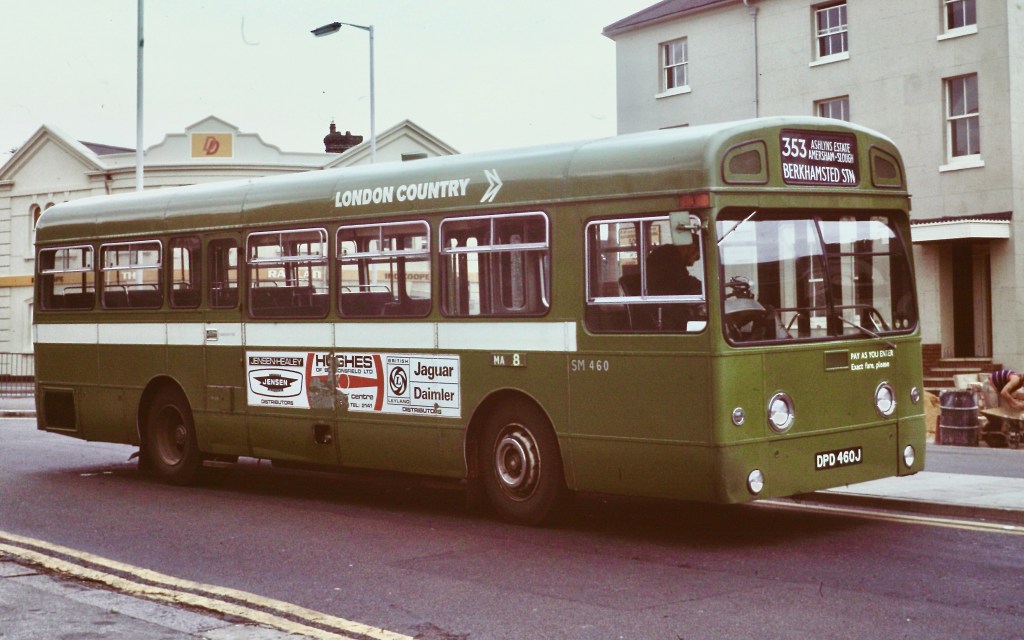
A London Country bus in the original NBC green livery adopted in 1972: AEC Swift DPD460J at Berkhamsted August 1974. Photo: I T Langhorn. 
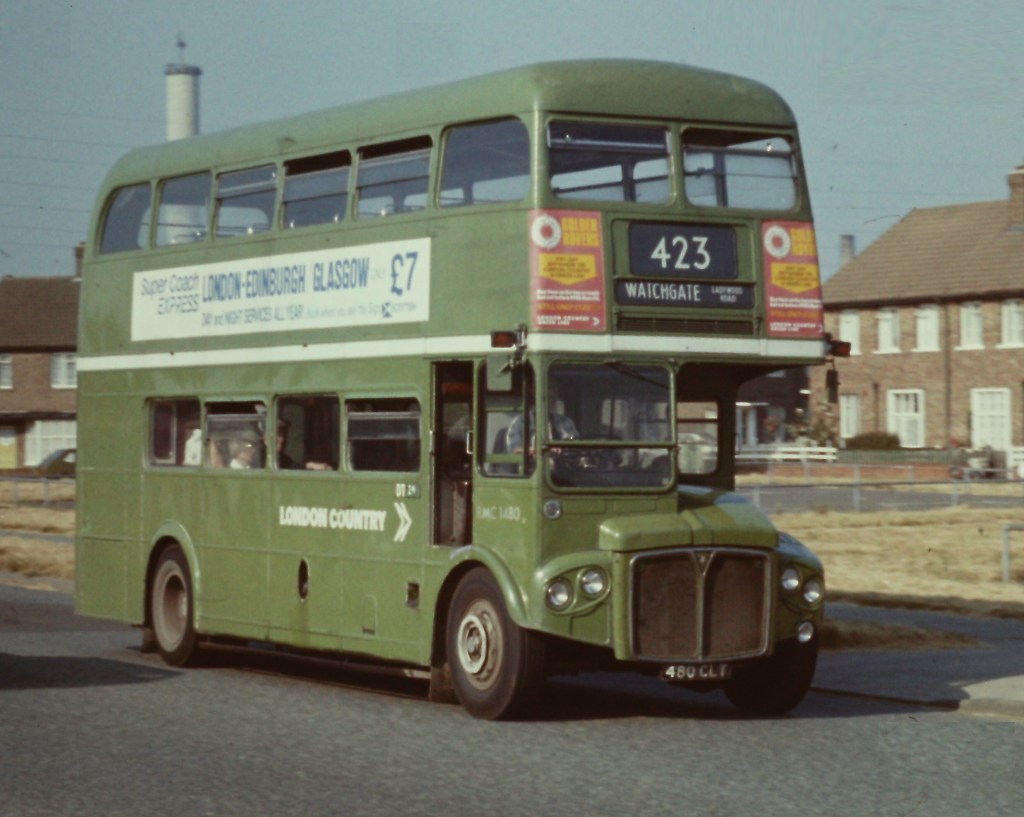
A classic London bus in NBC’s corporate green: former London Transport Routemaster coach RMC1480, converted for use on local stage services, on the outskirts of Dartford in the early 1970s.  Richard Price Collection.

The adoption of a new livery was the biggest and most striking change. The previous dark London Transport country-area green and the green/yellow London Country identity was replaced by the much lighter shade of National green, with white NBC symbol, fleetnames and relief stripe. Out went the familiar London Transport Johnston typeface, replaced on vehicles by Norman Wilson’s chunky modern National lettering with detailed labelling in Futura. This was not, in Bernard’s view, an improvement. “The shade of green chosen seemed to be very insipid compared with the older colour. Moreover it faded very badly over time, giving an inconsistent pale blue-green shade. This eventually improved as better-quality paints were sourced by NBC.”

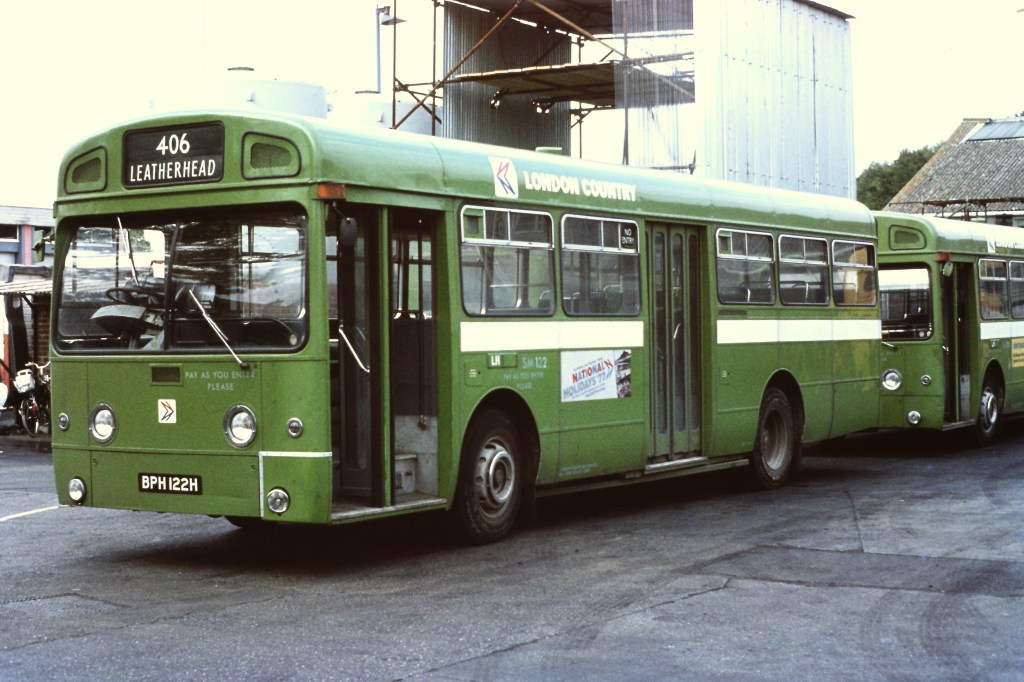
In the revised post-1976 bus livery, with the two-colour version of the NBC symbol. AEC Swift BPH 122H waits at Leatherhead in September 1977. Richard Price Collection
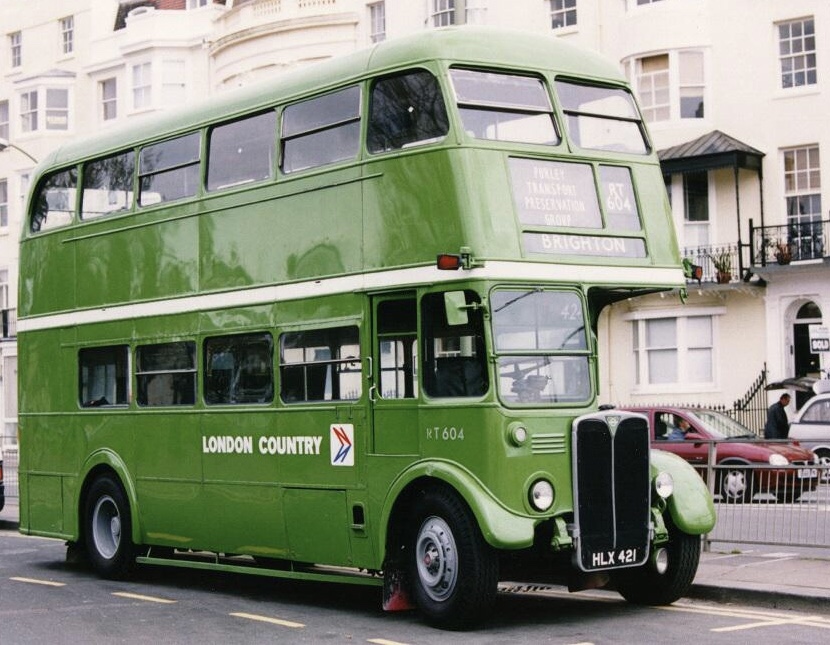
A touch of modernist design gave a new lease of life to many of NBC’s older vehicles. The adoption of leaf green was unpopular in many parts of the industry, particularly in the London area where it replaced London Transport’s long-established country-area dark green. It generally had its intended effect of giving even the oldest vehicles a modern(ist) look and projecting a progressive, confident image to users. Immaculately-preserved RT, RT604, new in July 1948 and seen here at a rally in Brighton, illustrates the effect well. Picture: Michael Ellis, Purley Transport Preservation Group
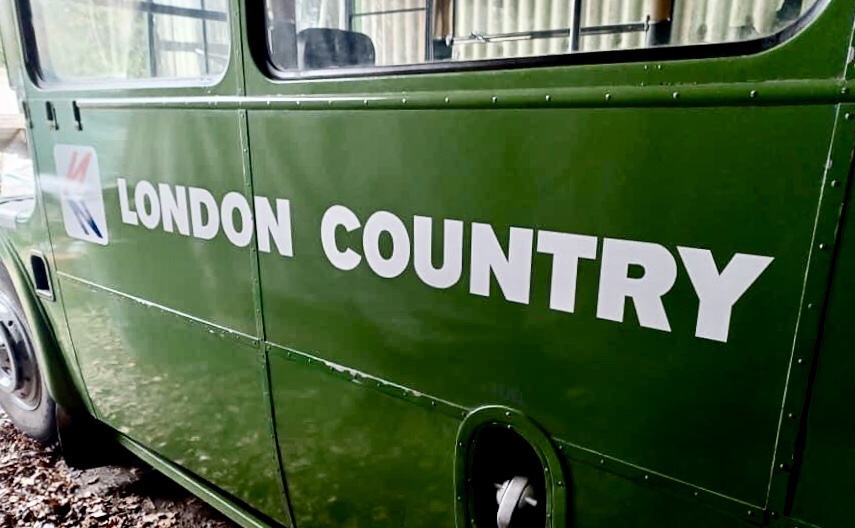
London Country’s ‘company identifier’, as the Manual described fleetnames, set in Norman Wilson’s National lettering. RT604 carried the revised NBC livery for a year before it was withdrawn and preserved in 1977. Photo: Michael Ellis.

There was a significant gap in the early thinking on the new NBC identity. “At first, the importance of regional long-distance coaches was not understood by NBC and its designers” Bernard recalls. “’Just paint them green’ they said. But regional coaches needed to be distinguished from local bus services – they were a very different proposition for customers.” The need for a distinctive appearance for what NBC called ‘semi-coach’ or ‘dual-purpose’ livery was largely overlooked until later in 1972 – well into the roll-out of the new coach and bus liveries. Indeed, the use of those terms – rather than ‘regional coach’ – perhaps reveals a lack of appreciation of the importance of regional express services both for customers and commercially.

For London Country, its Green Line coaches represented a significant part of the business. The company lobbied hard for an approach which differentiated these services. There were increasingly anxious requests for guidance on what to do from several NBC operating companies through 1972, as instructions emanated from headquarters to accelerate the roll-out of the new liveries in all-over white, green or red – but without acknowledging the regional coach category.

A group of buses parked next to each other

Description automatically generated with low confidence
With its Green Line network, regional express services represented a large and important part of London Country’s businesses. Along with other operators. The company was instrumental in pressing NBC to develop a colour scheme to distinguish these services from normal stage bus routes. NBC called this its ‘dual purpose’ livery, though in many cases the vehicles used, equipped with coach seating, were dedicated to express services and not dual purpose at all. In February 1973, soon after the new livery was adopted, newly-repainted Green Line AEC Reliance CUV65C is seen at Aldgate on route 723. Richard Price Collection

Some companies proposed to use the white livery with a thin mid-height band in red or green; or to use all-over white with the local operating company name. London Country was influential in the development of the approach eventually adopted by NBC – with ‘semi-coaches’ using a variant of the local bus livery, but with the upper half painted white above a lower half in National green or red – and in London Country’s case, Green Line branding.

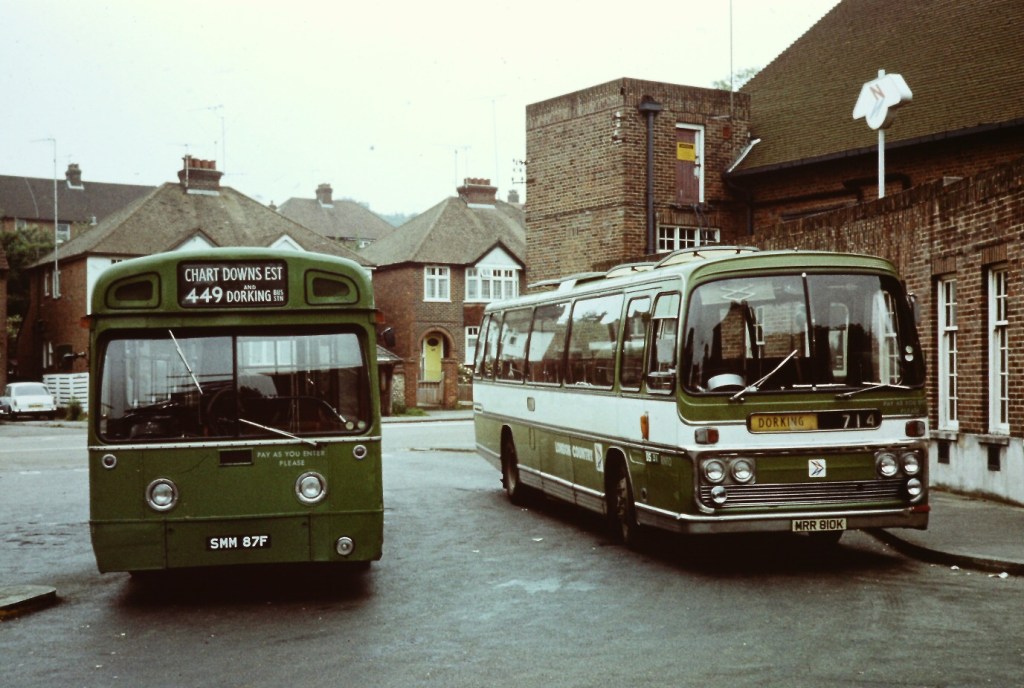
A London Country Merlin single-decker in NBC green with AEC Reliance coach in a version of London Country’s regional coach livery, at Dorking bus station in June 1979. The bus station’s ‘winged polo’ sign – part of London Country’s 1970 identity – has been altered to incorporate the NBC symbol. Photo: Jeff Jones.

In the late 1970s, London Country was influential in a further re-branding, for a re-launch of its Green Line coach network. The company got special dispensation from NBC headquarters for a new regional coach livery – a white coach with a broad green band incorporating the red and blue National symbol on a white background, and Green Line branding in large white National Alphabet lettering. Similar designs for regional coach services were later adopted by other NBC subsidiaries – for example, Eastern Counties’ ‘Eastline’ network in the early 1980s.

Green Line’s LNC45 in the NBC regional coach/dual purpose livery at Ilford in 1974. Tony Whitehead/National Bus Company.
An updated version of Green Line’s regional coach livery: Leyland Tiger WPH 130Y in 1982. Richard Price Collection.

As the manager responsible for producing all of the company’s publicity material, Bernard found the corporate identity’s guidelines on publicity helpful. “The new identity – the symbol, typefaces and so on – was helpful in many ways as it provided a good framework for our own creativity. NBC, like the Tilling Group before it, had a central publicity department in the 1970s which was there to help companies with material and design, but they never dictated what was used. At the time I poked fun at the new concept, but I embraced its value in virtually everything we produced.”

London Country timetables using local artwork to an NBC design template, 1978.

NBC produced a catalogue of standard advertisements and graphics each year which could be used locally in press, leaflets and bus-side advertisements, but operating companies were free to adapt them for local circumstances. “There was no real pressure or constraint on local publicity” Bernard recalls. “While the use of advertising for National services was totally standardised, there were few rules for local advertising – other than the use of the NBC symbol and typeface for company names, and a few specific rules such as the size and format of local bus timetables.

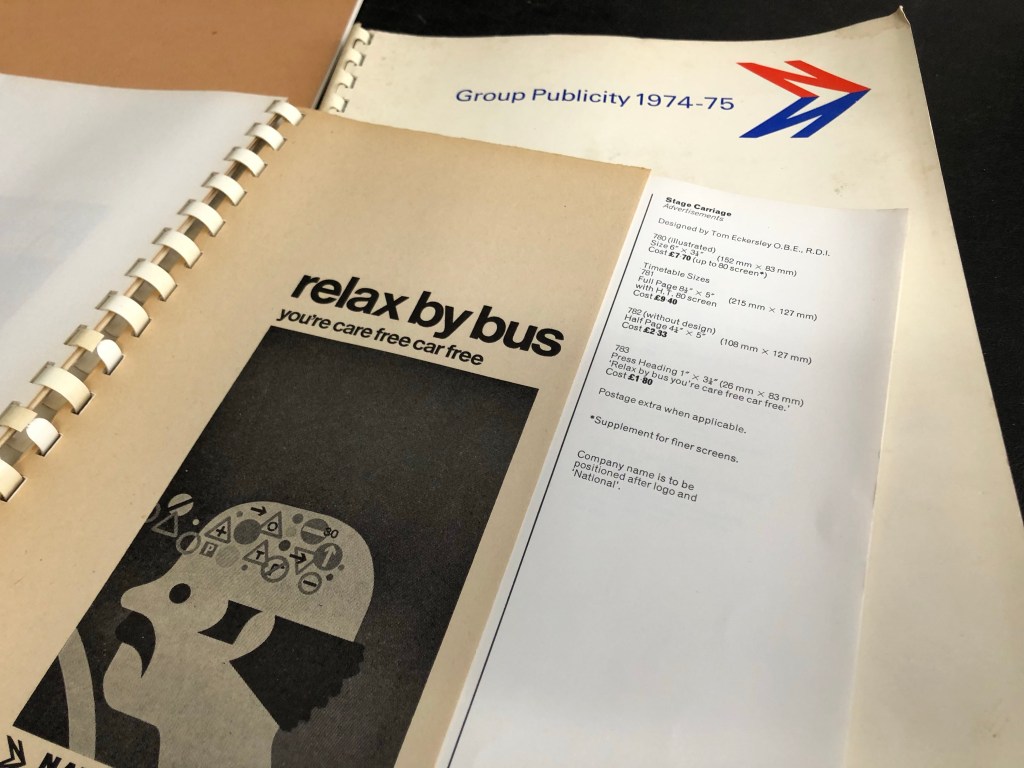
Pages from the NBC Group Publicity catalogue for 1974-75, showing various sizes of an advertising poster using designer Tom Eckersley’s fine ‘relax by bus’ illustration. The poster uses Helvetica, rather than Norman Wilson’s preferred Akzidenz-Grotesk, which was specified in the manual for use on signage. Photo: Richard Price/Bus Archive

Bernard was party to a strange incident at the very start of the roll-out of the new identity. As for all NBC companies, photographic negatives of the NBC symbol and the company’s fleetname in the new National lettering were sent to London Country, so that they could be faithfully produced on stationary, publicity and signage without anomalies. (The vehicle transfers were supplied centrally by NBC for the same reason.)  “Ours arrived, and I had to get straight on the phone to NBC headquarters.” Bernard remembers.  “I rang up and asked if they had decided to rename the company.”  In slight disbelief, Bernard found that the negatives he has been sent for use across the entire company read not ‘London Country’ – but ‘London Counties’.  A few moments of horror followed at the other end of the telephone line. After rapid consultation, the instruction from NBC headquarters was: “Destroy it!”.  Happily for posterity, this stern instruction somehow slipped Bernard’s mind, and the negative is still in his possession.  For this project – and for the first time in nearly 50 years – Bernard used the negative as intended to give a faithful reproduction of an exceptionally short-lived official NBC fleetname: LONDON COUNTIES. 

‘London Counties’ company identifier, from the original negative mistakenly issued by NBC headquarters in 1972 for London Country’s use. Source: Bernard Davis.

Many thanks to Bernard Davies for talking to us about his experiences at London Country and for sharing items from his collection; to the Bus Archive for access to the NBC publicity catalogues and to Michael Ellis of the Purley Transport Preservation Group and John Atkinson, for the photographs of RT604.

Categories
Alder Valley Applying the identity Bristol Crosville Devon General East Kent East Midland Hants & Dorset London Country Northern Potteries / PMT Ribble Southern Vectis Trent Welsh National West Riding Western National Yorkshire Traction
Innovating at the edges: the corporate identity and service vehicles

Local companies adapted the NBC corporate identity to service vehicles, producing some interesting (and occasionally wild) innovations.

Michael Hitchen, author of the leading book on the subject (see links at the end), presents a guest blog on the way NBC’s corporate identity guidelines were adapted (and widely ignored!) for local companies’ service vehicles.

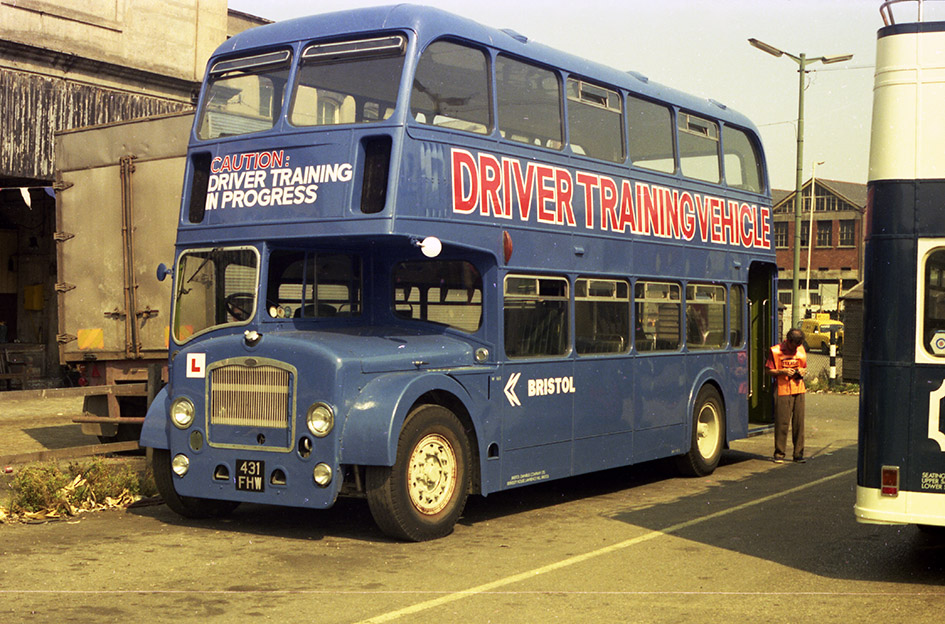
Although the National Bus Company had existed since 1969 it would not be until 1972 that detailed Corporate identity instruction were issued. These included every facet of the organisation activities, including livery instruction on the Service Fleet, a mixed range of vehicles from vans, lorries, recovery vehicles, trainer vehicles and a range of miscellaneous types.

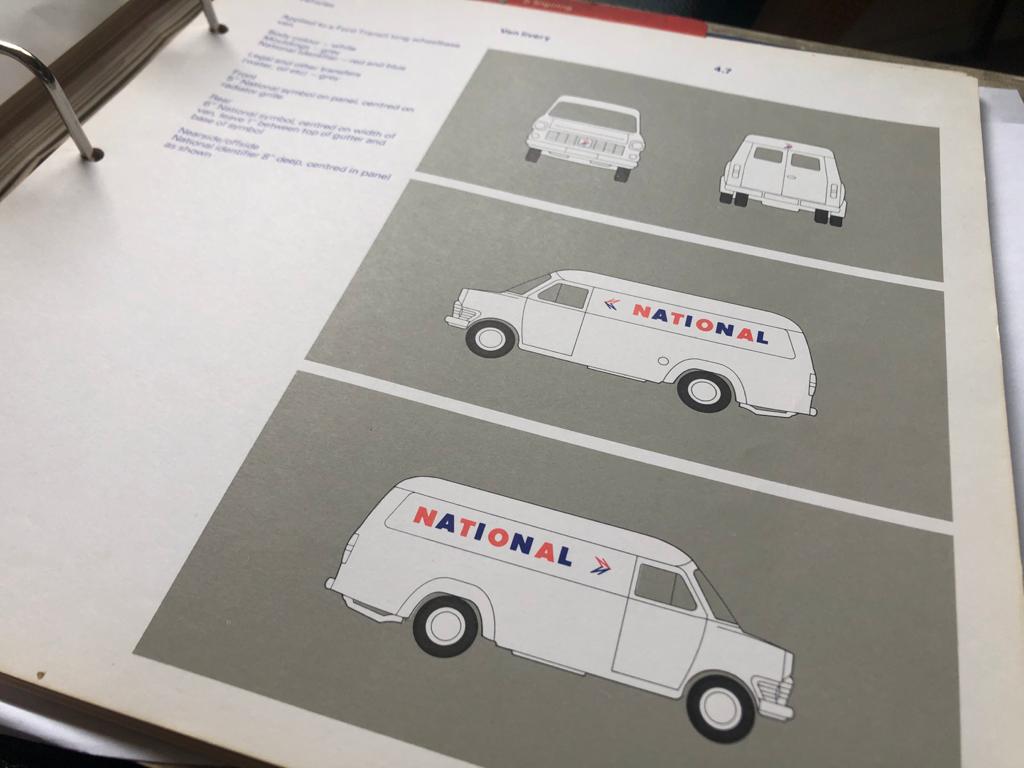
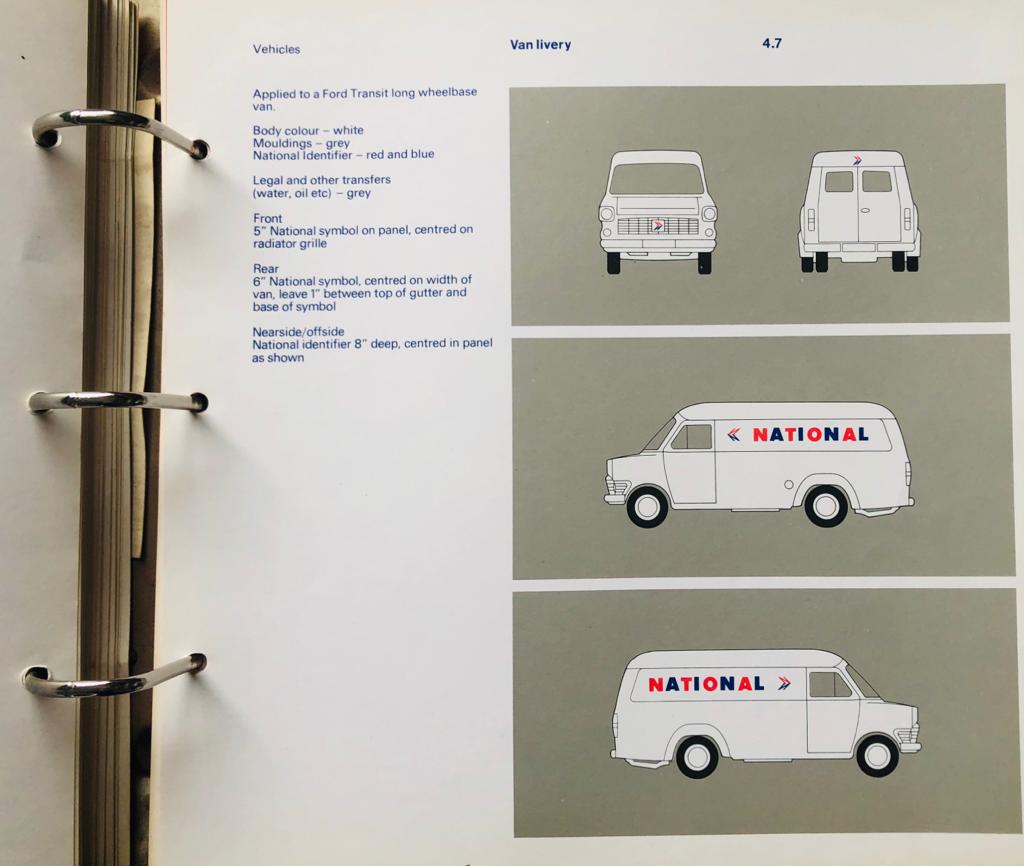
The 1975 NBC manual had only this to say on applying the corporate identity to service vehicles. Local company identities were not envisaged.

Reference to the appropriate page shows a medium size van as an example for the prescribed application. Unlike PSV vehicles where interpretation was relatively restricted, the Service Fleet was far more varied and the NBC allowed this one illustration to guide all other types of vehicle. This should have been straightforward as basically it was a variation on the Central Activities Group (CAG) coach livery, all-over white with red/blue NATIONAL lettering. Oddly, apart from the small legal lettering, there was no advice for the fleetname, which for CAG coaches initially had been a very small ‘company identifier’ underlined in the local company’s bus fleet colour, so if followed as per the manual, these vehicles would have been left anonymous across the NBC fleet.

Image 1 Trent A30 AEC Militant, as per corporate guidance, apart from the inclusion of Trent in red.

While that was the official guidance, in practice each fleet choose its own interpretation. A few did follow guidelines to a certain extent: Trent was a good example of compliance, with white applied to most of its ancillary fleet apart from its tree-lopper, which received all over yellow.

Image 2 Trent A55, again in the mid-1970s Trent followed the manual closely. A55 was a Bristol LD Driver training vehicle.

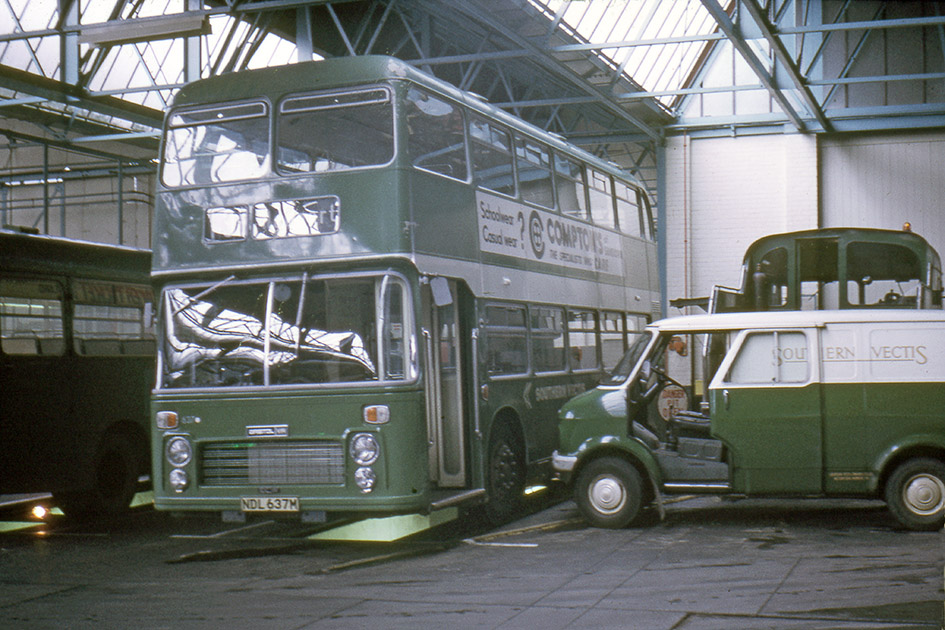
Ribble followed for its Trainers and some Breakdown lorries. East Kent and Alder Valley also had white vans, though Alder Valley replaced NATIONAL with its fleet name, as did Oxford South Midland.

The rest of the fleet contained a huge variety, rule of thumb was the use of the fleets base colour, ie Grass Green or Poppy Red, though I have no evidence of NBC Blue being used on Service Vehicles.

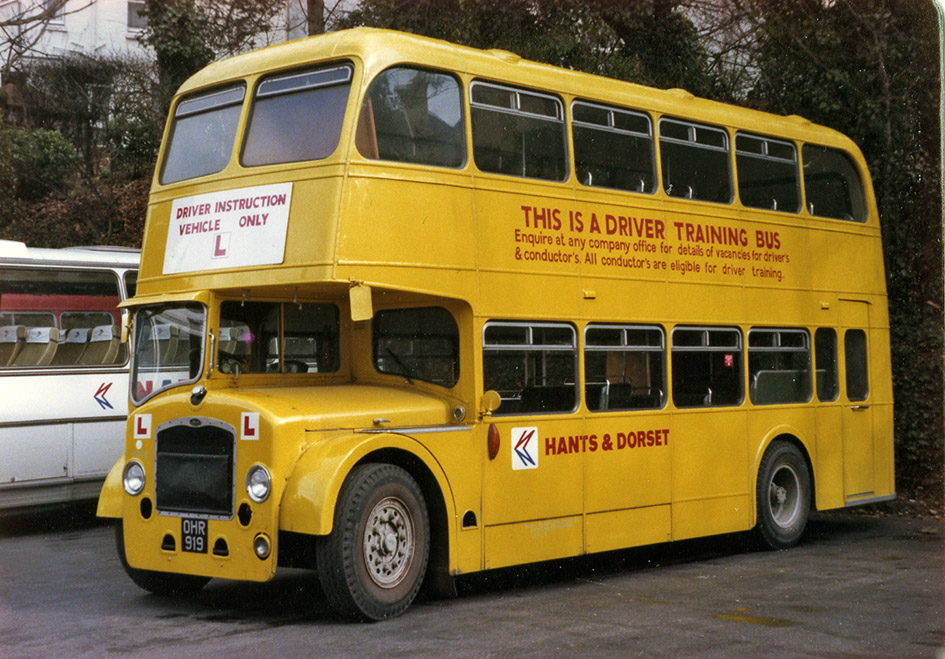
Image 3 Hants & Dorset 9092, apart from the corporate fleet name, Hants & Dorset applied carried this livery over in 1972, with a recruitment message along with the lettering stating the bus’s use.

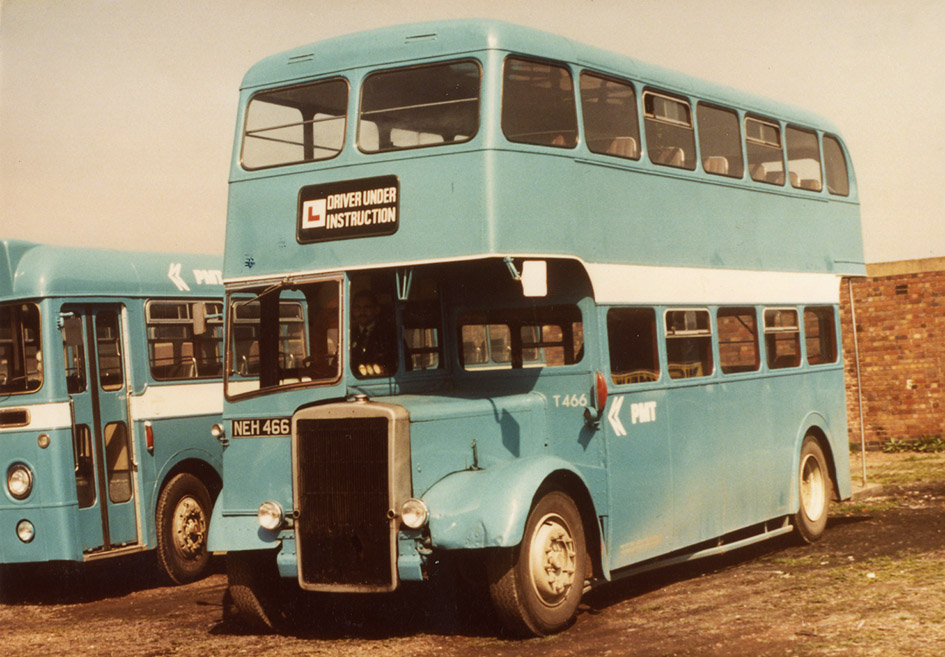
Variation of this application depended on the company, Crosville choose unrelieved Green on its vans and lorries and a dual-purpose livery for its recovery vehicles including it impressive AEC Matador Heavy Recovery Vehicle. National Welsh treated its vans in dual-purpose red/white but used yellow for its Recovery and training vehicles. South Wales often used red or yellow but with no fleet name. With these vehicles, variation was the running theme across the corporate NBC! The livery of Training vehicles depended on the fleet, Western National, Maidstone, Hants & Dorset, Eastern Counties use all over yellow, with variations on lettering; Eastern National and latterly Bristol, had used all over dark blue, Crosville applied a broad white band between the decks, as did Lincolnshire.

Image 4 Bristol W160, after years of using cream with an orange band, Bristol adopted the same livery for trainers as Eastern National.
Image 5 PMT T466. Potteries trainer T466 display the unique non-standard blue in use in the mid-1970s, letter it used yellow.

Occasionally this lack of strict abidance would see the discreet way of continuing pre-corporate practices, initially Bristol applied Orange/Cream to much of its SV fleet, Southern Vectis applied underlined gold serif fleet names on its dual-purpose liveried van for a time and West Yorkshire perpetuated its use of non-standard green to the majority of it service fleet (apart from Trainers) throughout the 1970s!          

Image 6 East Midlands T2. For its small fleet of trainers East Midland was another company to adopt a unique non-standard livery, this time a shade of dark red
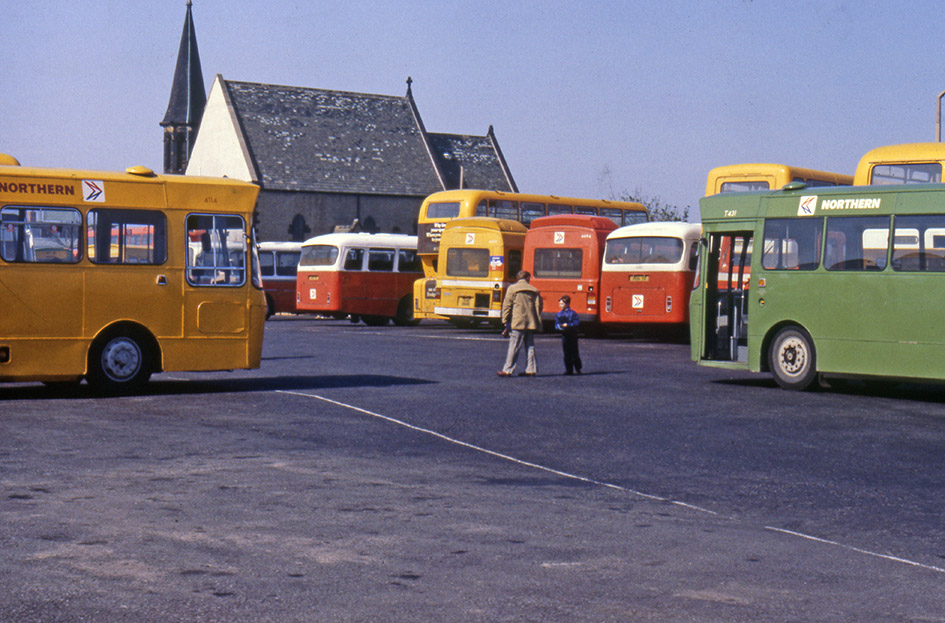
Image 7 Northern T431. Northern General was unique with the NBC in using yellow for its service buses, where they were in cooperation with Tyne & Wear PTE, therefore it changed to green for it Training vehicles, to avoid confusion with its buses. This photo illustrates the reasoning for this colour!

It would not be possible to list the huge variety of interpretation that companies used, many changing within the corporate period! As time progressed particularly into the 1980s livery guidance changed as well, yellow became the standard livery for Heavy Recovery lorries, possibly because of legislation, vans could be seen carrying adverts to promote commercial activities, and vans could be seen in standard factory colours, possibly a cost saving measure, or just white as they where meant to be from the start!        

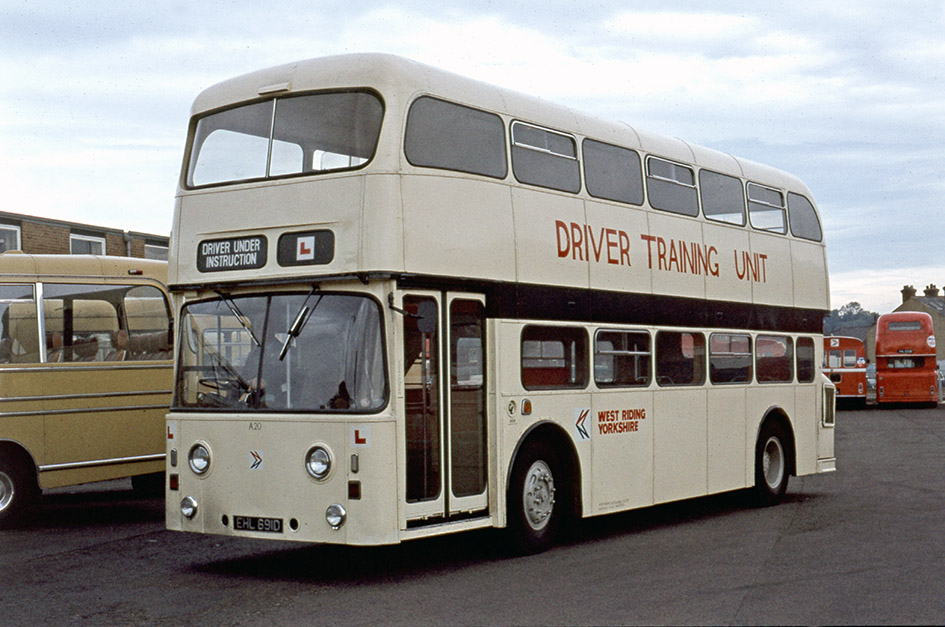
Image 8 West Riding A20. West Riding applied cream and black to its trainers, along with some bespoke signwriting which would have attracted the disapproval of NBC’s central projects team. Yorkshire Traction did also use similar livery for some of its training fleet.
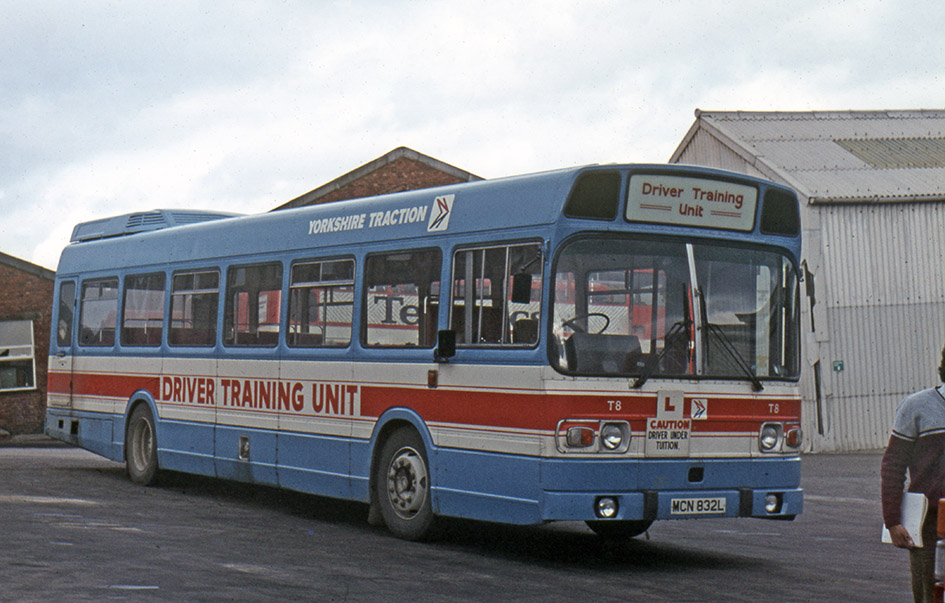
Image 9 Yorkshire Traction T8, in the mid-1970s YTC changed to this distinct Red, White and Blue livery for its driver trainers, latterly this livery could be found on some West Riding/Yorkshire trainers.
Image 10 National Welsh E8. The Western Welsh group favoured all over yellow for its recovery and training fleet from 1972 onwards, Bristol MW E8 is typical of its application.
Image 11 Bristol W144. Bristol had used Orange/Cream prior to 1972 and perpetuated this into the corporate era for a number of service vehicles, though this Bristol MW conversion has white in place of the cream.
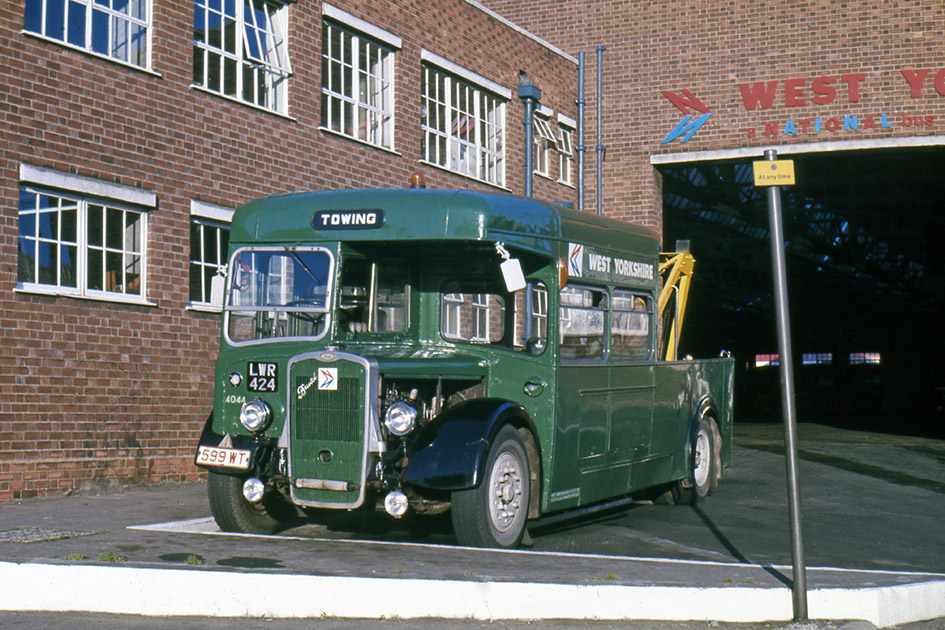
Image 12 West Yorkshire 4044. West Yorkshire a Poppy Red company continued using green for the majority of its service fleet throughout the 1970s. Bradford’s’ attractive recovery vehicle 4044 survives in preservation in this livery. 

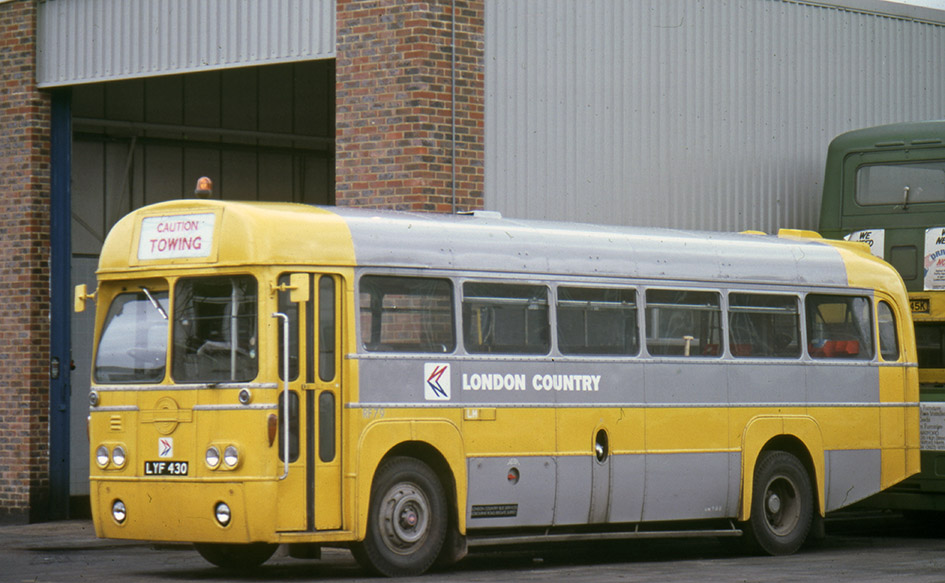
Image 13 London Country RF79. LCBS converted three AEC RFs into Towing vehicles, all receiving variations on the yellow and grey livery. LCBS was formerly part of London Transport, which used grey for many service vehicles.
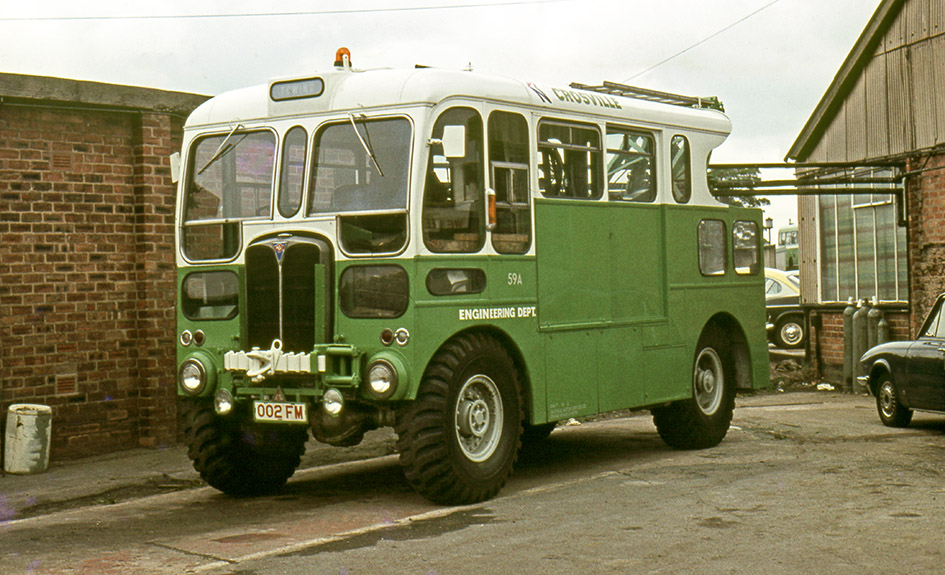
Image 14 Crosville 59A. After 1972 Crosville used only NBC green (some with white) for all its service vehicle, only in the 1980s did other colours appear, AEC Matador 59A, seen here, eventually received all over yellow.
Image 15. Western National RV8.  Western National group, including Devon General, used all-over yellow from 1972 for all its heavy recovery lorries, AEC Matador RV8, looks superb with its company-built bodywork.
Image 16. Southern Vectis 011. Southern Vectis Bedford CF van number 011 clearly show the use of pre-corporate lettering applied to the fleet’s vans in the 1970s.
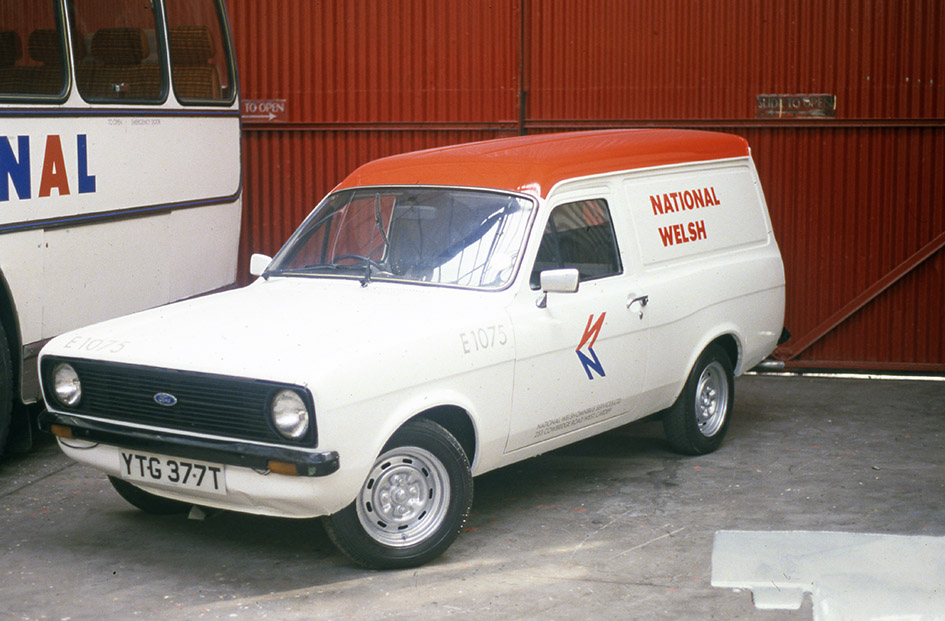
Image 17. National Welsh E1075. Yet more variety, Ford Escort Mk2 van carries white with a red roof. Later the company painted its small vans in a version of dual-purpose livery.
Image 18. Crosville G759. For other duties companies adopted bespoke liveries, Crosville’s Information bus G759 a Seddon Pennine, gained and orange and red stripe to the NBC green, other companies ‘MAP’ buses received a range of bespoke liveries. 
National Bus Company Service Vehicles 1972-1986 by [Michael Hitchen]

Many thanks to Michael Hitchen for providing this guest blog, including the photographs from his own collection. Michael is an authority on NBC’s liveries, and his book on NBC’s service vehicles is available from Amberley Books here: National Bus Company Service Vehicles 1972-1986 – Amberley Publishing ; and also from Amazon in hard copy or Kindle format.

Categories
Applying the identity Bristol Design East Kent London Country Staff

National uniformity

As part of its comprehensive rebranding, NBC’s corporate identity extended to what its staff wore.

The NBC Corporate Identity Manual is best known for its uniform bus and coach liveries. But it was also intended to address standardisation of a wide range of other aspects of NBC’s presentation to its customers, including clothing and uniforms.

NBCs constituent companies had started experimenting with uniforms as part of their coach branding – in this example, East Kent adopted bright orange uniforms for coach hostesses with a cut and cap reflecting fashions of the era during the late 1960s. The driver on the other hand sports a contrasting very traditional uniform.

Section 7 of the NBC Corporate Identity Manual dealt with “uniforms and related items” such as cap and jacket badges.  But there is some mystery over section 7. We believe it was drafted – indeed NBC put a lot of work into uniform design – but may not have been issued: curiously the copies of the Manual we have seen omit it. We’ll be digging deeper into this over the coming months to make sure that a reissued corporate identity manual includes as much of the issued material as we can source. Please get in touch if you can help.

NBC’s constituent companies inevitably had a variety of styles, many unchanged  since the 1950s.  With a few exceptions – notably innovations in the coach market to reflect the speed and modernity of the emerging national motorway network – uniforms tended to be very traditional with heavy wear-resistant fabrics in black or dark blues, round peaked caps and occasionally traditional braid to indicate seniority.  Coach crews often sported light-coloured overalls and matching caps.  But – as with liveries – there tended to be substantial variation between local companies.

NBC’s corporate identity sought to do away with all that, and to introduce a standard look for crews and bus station staff. Crews and staff were to be the human face of the business, so their attire needed to reflect the modernity the business aimed to project. NBC and Norman Wilson’s team wanted staff to project the company’s modern image as much as the vehicles, and investigated overseas practice as well as drawing inspiration from constituent companies’ innovations in the coach market.

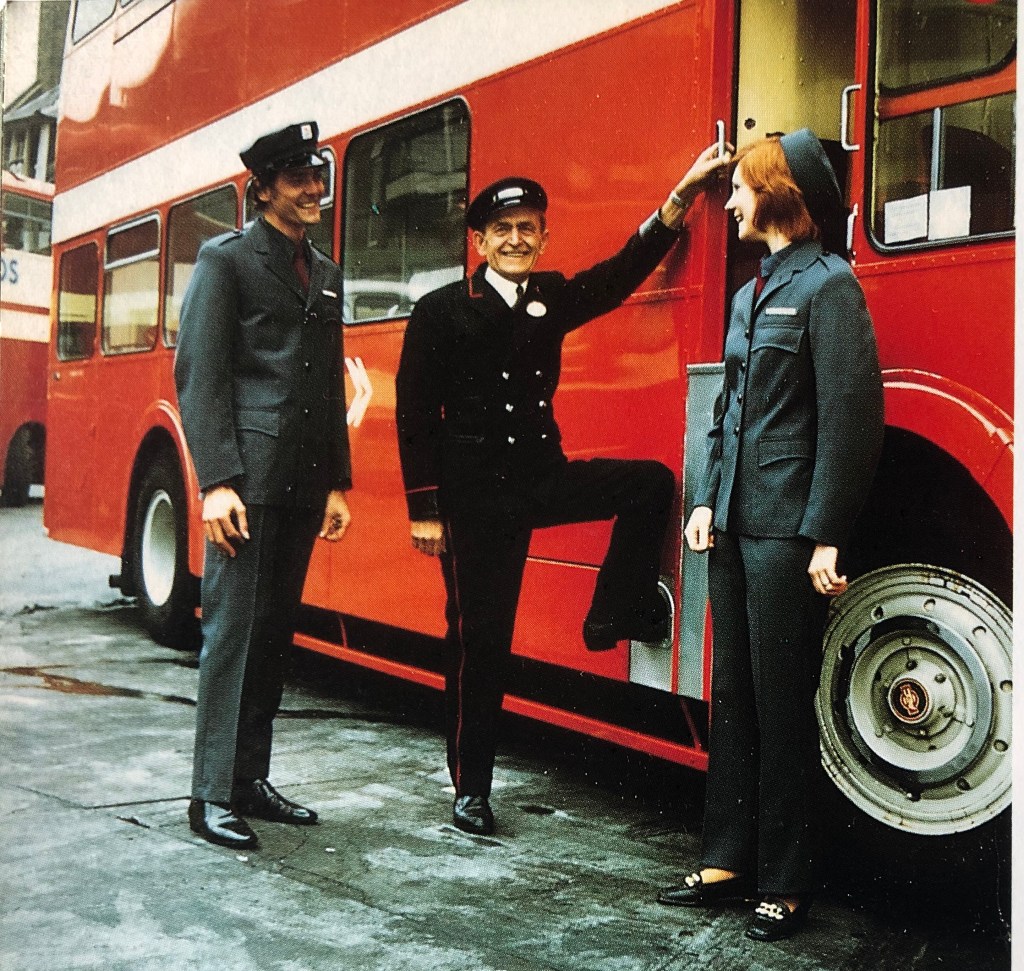
Bus crew uniforms saw a radical change. Adopting a much more modern look, Wilson and his team adopted a sleek modern-cut in a blue-grey serge, with a similar lightweight version for summer. The cut of the uniform for women was very similar, but with a simpler cap. In this NBC publicity shot at London’s Victoria Coach Station, models Ray Rhodes and Judy Neale show off the new look, contrasting with driver Alf Vassey, of East Kent’s Dover depot, who wears the company’s very smart traditional uniform. They pose with an East Kent AEC Regent in the new corporate colours

Out went dark colours, and in came lighter blue-grey suits with a relatively modern cut, greater comfort and incorporating larger pockets to assist with carrying paperwork. Out went the traditional round peaked caps and in came a modern, Germanic-looking octagonal cap in the same shade of blue-grey, sporting a smart metal ‘double-N’ arrow badge.

In new NBC uniforms with London Country badges, Ray Rhodes and a fellow professional model pose for a publicity shoot in 1972. The uniform for men incorporated a radically different octagonal cap design, almost unseen in Britain but more common in northern mainland Europe. For women, a cleaner-cut pillbox hat was adopted.

Office and counter staff at bus stations counted among them many more women than the drivers and crews. Various uniforms were created for women over the years, typically in brighter hues of the corporate colours, with styles evolving with fashion more than the men’s uniforms.

A Bristol Omnibus Company driver wears his octagonal crew cap, during a driving demonstration for the NBC training film ‘They don’t grow on trees’, made in 1979.
The women’s coach uniform came used various combinations of the corporate colours – here is an early variant in corporate blue and lined in red.

Whereas the changes in bus liveries are well documented, pictures of the changing uniforms through the NBC period are relatively few and far between. If you have any photos you’d be happy for us to use to illustrate the evolving staff attire for bus and coach crews and for bus station staff, do let us know. We’ll add any photos and stories in the coming weeks.

NBC’s corporate identity picked up on the best of its constituents’ designs – shown here, an early coach hostess uniform, similar to the East Kent National Travel version above, but in the NBC colours.

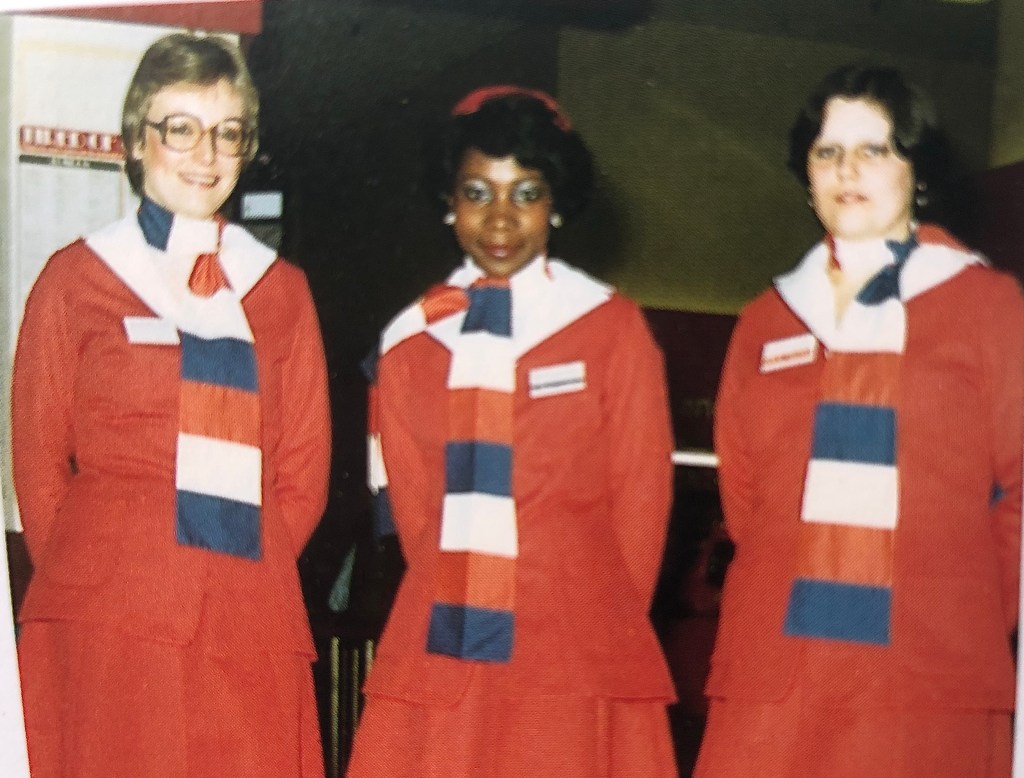
While the men’s uniform changed relatively little until the 1980s, women’s uniforms were more regularly updated as styles changed. This version shows a variant of the bus station staff uniform from the early 1980s.
Coach staff saw more change during the NBC period than their bus counterparts. Here we see the male and female uniforms adopted in the early 1980s for National Express drivers and crew.